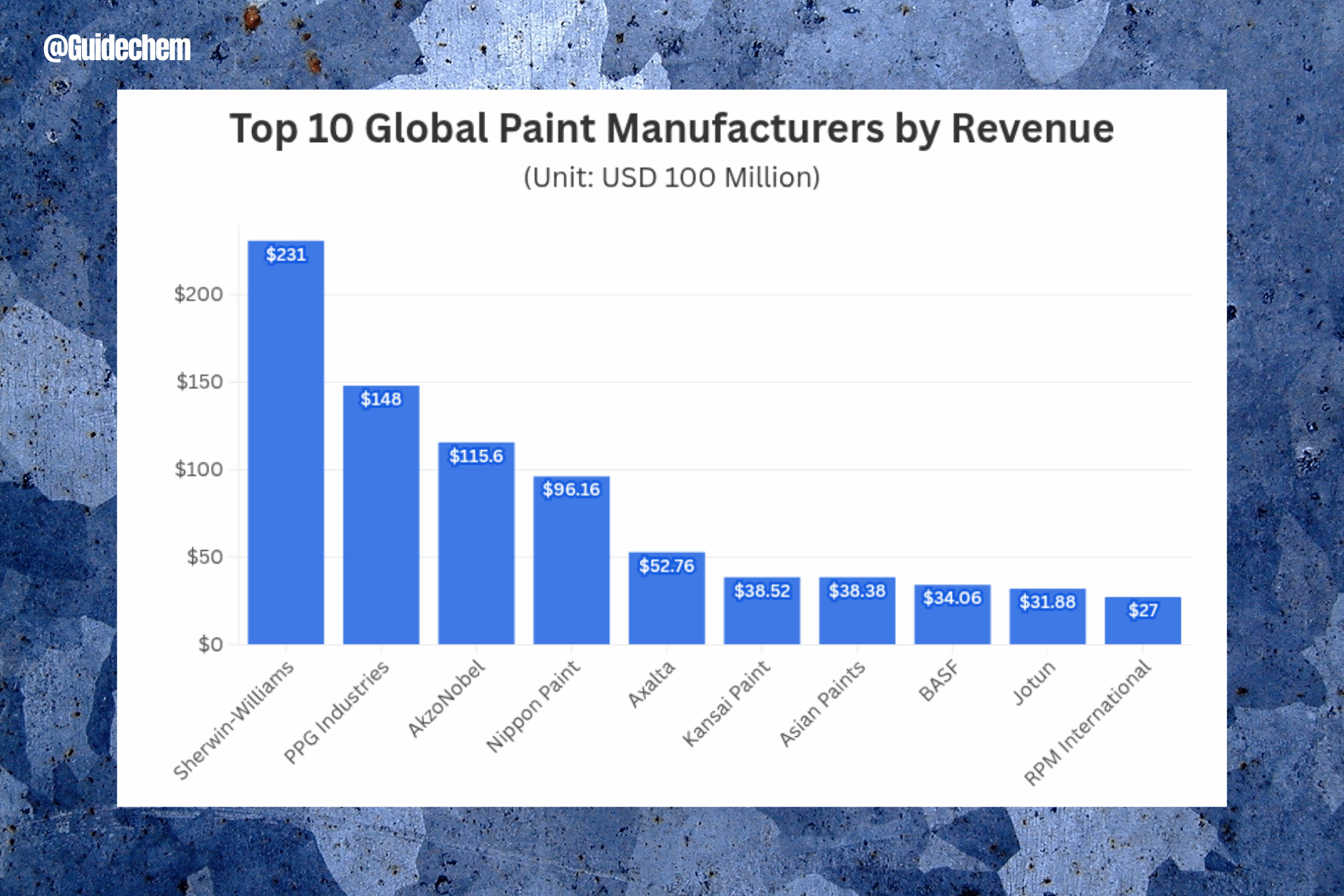
U.S.-based Sherwin-Williams topped the global coatings industry once again with $23.1 billion in sales and an 11.41% global market share, remaining the only company with a market share above 10%. This marks the 11th consecutive year Sherwin-Williams has made the ranking and the 6th consecutive year as the global leader.
Founded in 1866 and headquartered in Cleveland, Ohio, Sherwin-Williams is one of the oldest professional coatings companies in the world. Over more than 150 years, the company has grown steadily into the largest coatings enterprise globally. Today, it operates through three major business segments: The Paint Stores Group, Consumer Brands Group, and Performance Coatings Group, with operations in over 120 countries and regions.
The company’s product range spans architectural coatings, wood coatings, packaging coatings, industrial protective coatings, automotive coatings, coil coatings, marine coatings, powder coatings, and more. Notable brands under its umbrella include Sherwin-Williams, Valspar, Huarun Paint, Becker Acroma, Aquaspar, Sayerlack, and Inchem. By the end of 2024, Sherwin-Williams had 63,890 employees worldwide.
Data shows that in 1977, Sherwin-Williams’ revenue was only $1 billion. By 2008, it had exceeded $8 billion, ranking as the world’s third-largest coatings company. In 2015, sales surpassed $10 billion for the first time, placing it second globally. After acquiring Valspar in 2017, Sherwin-Williams overtook PPG to become the world’s largest coatings manufacturer. It has now held the top spot for six consecutive years.
According to its annual report, Sherwin-Williams’ sales rose from $11.139 billion in 2015 to $23.1 billion in 2024, a 107.38% increase over ten years with a compound annual growth rate (CAGR) of 7.85%. Net profit increased from $1.054 billion in 2015 to $2.6814 billion in 2024, marking a 154.40% growth with a CAGR of 15.18%. Both key metrics outperform competitors like PPG and AkzoNobel.
Despite the complex and volatile global economic landscape last year, Sherwin-Williams still achieved growth against the trend. The company’s 2024 full-year financial report showed net sales of $23.1 billion, a year-on-year increase of 0.2%, driven by low single-digit volume growth and price increases, partially offset by unfavorable foreign exchange rates. EBITDA reached $4.4915 billion, up 8.2% year-on-year; pre-tax profit was $3.4518 billion, up 11%; and net profit was $2.6814 billion, a 12.25% year-on-year increase.
Thanks to its sustained performance, Sherwin-Williams has continued to solidify its market leadership. It remains the only company in the world with a coatings market share over 10%.
In addition to sales, Sherwin-Williams also ranks among the top in net profit, net profit margin, and per capita output. Net profit is a key indicator of a company’s profitability and operational efficiency. In 2024, Sherwin-Williams led the industry with $2.681 billion in net profit. The total net profit of the world’s top ten coatings manufacturers was $7.7454 billion, of which Sherwin-Williams accounted for 34.61% — equivalent to the combined net profits of PPG, AkzoNobel, and Nippon Paint.
Net profit margin reflects a company’s overall economic performance. A higher margin indicates better profitability. Sherwin-Williams had an 11.61% net profit margin, ranking second. Additionally, the company ranked fifth in per capita output with $361,600 per employee, highlighting its strong profitability and operational efficiency, as well as its advanced manufacturing and management capabilities.
With its growing overall strength, Sherwin-Williams' brand influence and value have rapidly increased. According to the "2025 Global 500 Most Valuable Brands" list released by international brand valuation and strategy consultancy Brand Finance, Sherwin-Williams ranked 276th, retaining its title as the most valuable coatings brand globally. It has been the only coatings brand on the list for eight consecutive years.
Over 150 years ago, Sherwin-Williams was an unknown small business. Today, after more than 150 years, it has become the global coatings sales champion for six consecutive years and leads in several core indicators. How did Sherwin-Williams achieve this?
The answer lies in its focused and deep-rooted strategy. By concentrating on the high-quality segment of architectural coatings and maximizing its channel advantages, Sherwin-Williams has become the global leader in that area. At the same time, the company has built strong product, brand, and service capabilities through innovative business models and continuous investments in technology, marketing, and customer service. Furthermore, Sherwin-Williams’ global acquisition strategy has driven external growth, contributing significantly to its expansion.

