The United States is set to implement further export controls in the field of biotechnology.
On January 16 (local time), the US Department of Commerce's Bureau of Industry and Security (BIS) is expected to issue an Interim Final Rule (IFR) on export controls related to biotechnology laboratory equipment and technologies.
The rule will amend the Export Administration Regulations (EAR) to address the rapid development and deployment of advanced biotechnology tools, which the BIS believes may pose a threat to US national security and foreign policy interests. For the biotechnology sector, which requires global cooperation, the EAR amendment will undoubtedly bring more challenges.
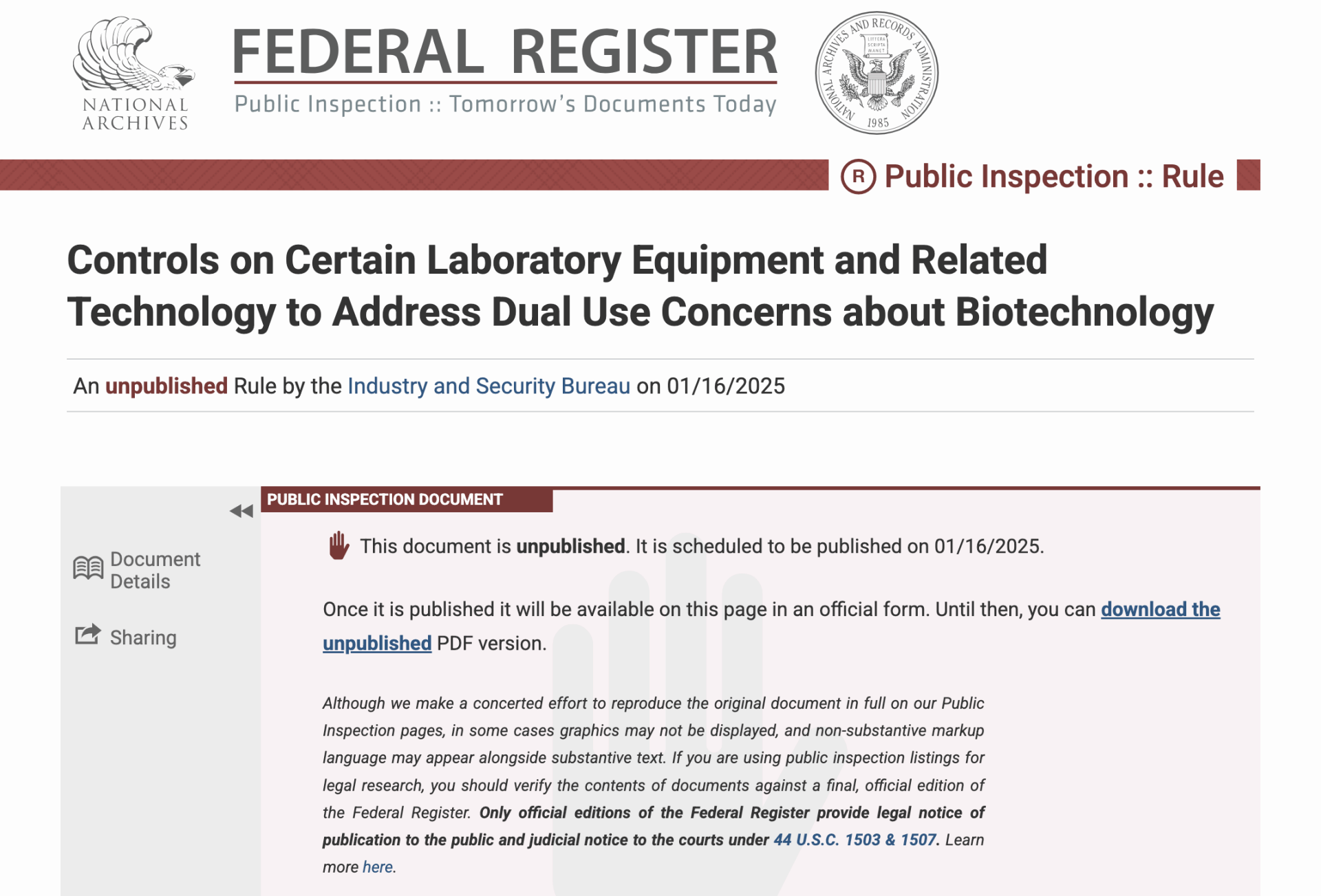
Controls on Certain Laboratory Equipment and RelatedTechnology to Address Dual Use Concerns about Biotechnology
The BIS highlights that while biotechnology has tremendous potential, its inherent dual-use nature presents risks.
Therefore, the executive order aims to protect the US from foreign adversaries gaining access to technologies and data that could threaten national security, while promoting ethical and responsible global development of biotechnology.
The US acknowledges the need to address both the benefits and risks of dual-use biotechnology, as the use of such technologies (particularly when combined with AI and biological design tools) could enhance the military capabilities of certain countries, lowering the threshold for designing, deploying, and using new weapons.
According to the 2024 Annual Threat Assessment Report from the Office of the Director of National Intelligence, the integration of new technologies in areas such as AI and biotechnology could lead to breakthrough developments, quickly advancing capabilities that pose asymmetric threats to US interests. Some countries are actively pursuing combinations of biotechnology and other enabling technologies to gain asymmetric military advantages.
Given the dual-use nature of specific biotechnology equipment and its potential contribution to the development of certain military technologies, the BIS believes that it is necessary to implement moderate export controls on these equipment categories to limit immediate risks and prevent long-term national security threats.
The IFR primarily specifies two categories of equipment that will require additional export controls to help protect US national security. These two categories are:
For these, the IFR creates new export control classification numbers (ECCNs) to identify the high-parameter flow cytometers and specific mass spectrometry equipment:
For destinations outside Country Group A:1, export licenses will be required. For destinations in Country Groups D:1 and D:5, Macau, or Country Group E, license applications will be "presumed denied." For other destinations, such as countries only in D:1 but not D:5, the US will conduct case-by-case reviews.
In terms of transition provisions, goods in transit as of the IFR’s publication date can continue to be exported, re-exported, or transferred domestically under prior license exceptions or No License Required (NLR) eligibility within 30 days of the publication.
Although the IFR does not specifically mention China, China is typically included in Country Group D:1, meaning the new rules may apply to relevant equipment exported to China.
Historically, US export controls on China have focused on the EAR and related export control lists. For example, China is specifically listed in D:1, and countries in D:1 face strict restrictions on the export of technologies involving national security. On the Entity List, many companies and universities related to Chinese research institutions or technology development are restricted from purchasing US technologies.
If China were classified as both D:1 and D:5 (depending on its actions in the dual-use technology or military application fields), export licenses would be "presumed denied," meaning export licenses are typically not granted.
Furthermore, even if China is not part of D:5, exports to China would still be subject to case-by-case reviews to assess whether these items may pose a significant threat to China's military capabilities or to US national security.
Although the IFR does not require prior notice or public participation, the BIS still accepts public comments on this Interim Final Rule. The IFR will take effect on the date of publication in the Federal Register, with a comment deadline of 60 days from publication. The public can submit comments at www.regulations.gov. The rule's online links are https://federalregister.gov/d/2025-00723 and https://govinfo.gov.
In light of the previous controversies surrounding the Biosecure Act and other regulations, the impact of the IFR may not be significant.
Chinese companies, including WuXi AppTec, have increasingly faced US-related controls.
In December 2024, WuXi AppTec announced it would sell its cell therapy and gene therapy CTDMO business in the US and UK to the US-based equity fund Altaris. On January 6, WuXi Biologics announced it would sell its vaccine plant in Ireland to Merck & Co. Some industry insiders believe these sales are related to the "decoupling" tensions.
However, some professionals believe that the new controls could finally allow domestic Chinese equipment to take a larger share.
According to public data, in the first half of 2024, there were 399 procurement notices for flow cytometers in China, with a total of 438 units purchased, totaling 417 million yuan. The main brands and their market share were BD (42.11%), Beckman (25.15%), and Agilent (10.45%).
https://www.federalregister.gov/public-inspection/2025-00723/controls-on-certain-laboratory-equipment-and-related-technology-to-address-dual-use-concerns-about
https://public-inspection.federalregister.gov/2025-00723.pdf

