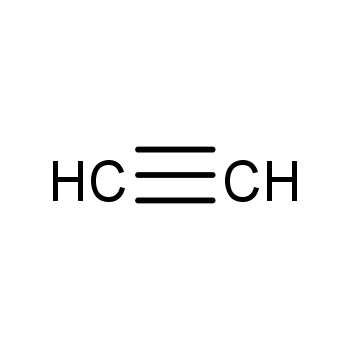
Acetylene, the simplest alkyne hydrocarbon, is a colorless, flammable, and unstable gas with a distinct pleasant odor. Acetylene derived from calcium carbide may exhibit a garlic scent due to traces of phosphine generated during the production process. In the petroleum industry, the term "acetylenes" is used broadly to encompass chemicals characterized by the carbon-carbon triple bond. First discovered in 1836 by Edmund Davy (1785–1857), acetylene was inadvertently produced during his attempts to synthesize potassium metal from potassium carbide (K2C2). In 1859, Marcel Morren in France generated acetylene by employing an electric arc between carbon electrodes in the presence of hydrogen. Morren referred to the resulting gas as carbonized hydrogen. Subsequently, Pierre Eugène-Marcelin Berthelot (1827–1907) replicated Morren's experiment three years later and conclusively identified carbonized hydrogen as acetylene.
The fortuitous discovery of a method for the commercial production of acetylene occurred in 1892 through the inadvertent experimentation of Thomas Willson (1860–1915). Willson, engaged in aluminum production at his enterprise in Spray, North Carolina, sought to generate calcium for the reduction of aluminum oxide, Al2O3. Utilizing an electric furnace, he combined coal tar and quicklime, intending to yield metallic calcium. Instead, the outcome was a brittle gray substance identified as calcium carbide, CaC2. This substance, upon reaction with water, produced acetylene. Willson's breakthrough prompted the establishment of numerous acetylene plants in both the United States and Europe in the ensuing decade.
The distinctive triple bond within acetylene imparts a high energy content that is liberated upon combustion. Following Willson's achievement, Henry-Louis Le Chatelier (1850–1936) observed that burning acetylene and oxygen in roughly equal proportions generated a flame of unparalleled intensity. Acetylene and pure oxygen, when combined, yielded flame temperatures ranging between 3,000°C and 3,300°C, sufficiently high for steel cutting. The exceptional heat emanating from acetylene combustion is not solely attributed to its heat of combustion, comparable to other hydrocarbons, but rather to the unique nature of the flame it produces. Acetylene swiftly combusts when mixed with pure oxygen, generating a flame characterized by a tightly concentrated inner cone. This results in the transfer of energy within a confined volume, consequently achieving elevated temperatures.
In the latter half of the 19th century, metal cutting torches utilizing hydrogen and oxygen were prevalent, with temperatures reaching approximately 2000°C. However, the advent of torches designed for acetylene use emerged in the early 20th century, revolutionizing metalworking practices. Additionally, acetylene gained widespread application in illumination. Portable lamps for miners, automobiles, bicycles, and lanterns utilized a mixture of water and calcium carbide to generate acetylene, producing a brilliant flame. Street lamps, lighthouses, and buoys also adopted acetylene for illumination; however, by 1920, its use as a light source had been superseded by batteries and electric lighting.
The stability of acetylene poses a significant challenge in its utilization. While acetylene remains stable under standard pressures and temperatures, exposure to pressures as low as 15 pounds per square inch gauge (psig) can lead to explosive reactions. To mitigate this stability concern, efforts are made to limit the transport of acetylene. For welding and cutting applications, acetylene is stored in pressurized cylinders, where it is dissolved in acetone. These cylinders feature a porous filler comprised of materials such as wood chips, diatomaceous earth, charcoal, asbestos, and Portland cement, with synthetic fillers also available. Acetone fills the voids in the porous material, allowing acetylene to be pressurized up to approximately 250 pounds per square inch (psi). This pressurized system, where 1 liter of filler can accommodate several hundred liters of acetylene, contributes to stabilizing the substance. It is imperative not to store acetylene cylinders on their sides, as this may result in uneven acetone distribution and the formation of acetylene pockets.
The conventional method of acetylene production involves the reaction of lime and coke to generate calcium carbide, subsequently combined with water to yield acetylene.

Alternative processes emerged in the 1920s, utilizing natural gas and petroleum products, such as thermal cracking of methane. This process involves heating methane in an oxygen-deficient environment to prevent complete combustion, leading to the cracking of methane into acetylene. Various hydrocarbons, including ethane, propane, ethylene, can serve as feed gases for acetylene production.
Approximately 80% of acetylene production is dedicated to chemical synthesis, with the United States consuming around 100,000 tons annually. While acetylene was extensively used in Germany for chemical synthesis in the past, its utilization has decreased due to the rise of ethylene as a feedstock and more economical production methods. Since 2000, the U.S. has witnessed a yearly reduction of approximately 50,000 tons in acetylene consumption. The majority of acetylene production now supports the production of 1,4-butanediol, a key component in plastics, synthetic fibers, resins, organic solvents, and coatings. Walter Reppe's pioneering Reppe process, employing acetylene in chemical processes, is giving way to newer methods utilizing propylene oxide, butadiene, or butane.

The unique triple bond in acetylene allows for various addition reactions, particularly with hydrogen and halogens. For instance, reaction with hydrogen chloride produces vinyl chloride, historically a significant precursor to polyvinyl chloride (PVC) before the 1960s. Due to acetylene's reactivity and instability, ethylene has become a more economical alternative since the 1950s. The addition of carboxylic acids to acetylene results in vinyl esters, such as vinyl acetate produced through the addition of acetic acid. Acrylic acid, once produced using Reppe chemistry with acetylene, is now more economically derived from propylene. Catalyzed hydrogen addition to acetylene yields ethylene, while acetylene itself can polymerize into polyacetylene.
Richard L. Myers (2009). The 100 Most Important Chemical Compounds: A Reference Guide. Greenwood Publishing Group. October 1, 2009. https://doi.org/10.1021/ed086p1182
 |
 |
 |


 4YRS
4YRS