The liver is an astonishing organ in the human body. It is responsible for multiple critical functions such as detoxification, metabolism, and nutrient storage, and it also possesses extraordinary regenerative capacity. Even after partial removal or damage, the liver can restore its mass and function. This regenerative ability offers great potential for the development of regenerative medicine.
Recently, scientists from the University of Barcelona and other institutions published a study titled "Sequential activation of transcription factors promotes liver regeneration through specific and developmental enhancers" in the journal Cell Genomics, revealing the key gene regulatory mechanisms underlying liver regeneration and laying the foundation for future medical breakthroughs.
Liver regeneration is a complex and delicate process involving precise regulation of gene expression. Under normal conditions, liver cells (hepatocytes) remain quiescent, but after partial hepatectomy (PHx), these cells re-enter the cell cycle and begin proliferating within hours. This process depends not only on the reactivation of the cell cycle but also involves widespread changes in gene expression. In recent years, through genomics and epigenetics studies, scientists have gradually uncovered the complexity of gene regulation during liver regeneration. However, many unknowns remain about the roles of specific gene regulatory elements in the regeneration process.
In this study, researchers analyzed gene expression and chromatin accessibility changes in mouse livers after partial hepatectomy to create a genome-wide map of gene regulatory elements involved in liver regeneration. They used RNA sequencing (RNA-seq) and Assay for Transposase-Accessible Chromatin sequencing (ATAC-seq) to analyze gene expression and chromatin states at 6, 24, and 48 hours post-surgery. These time points correspond respectively to the initiation phase of regeneration, the S phase entry, and the mitosis phase of hepatocytes.
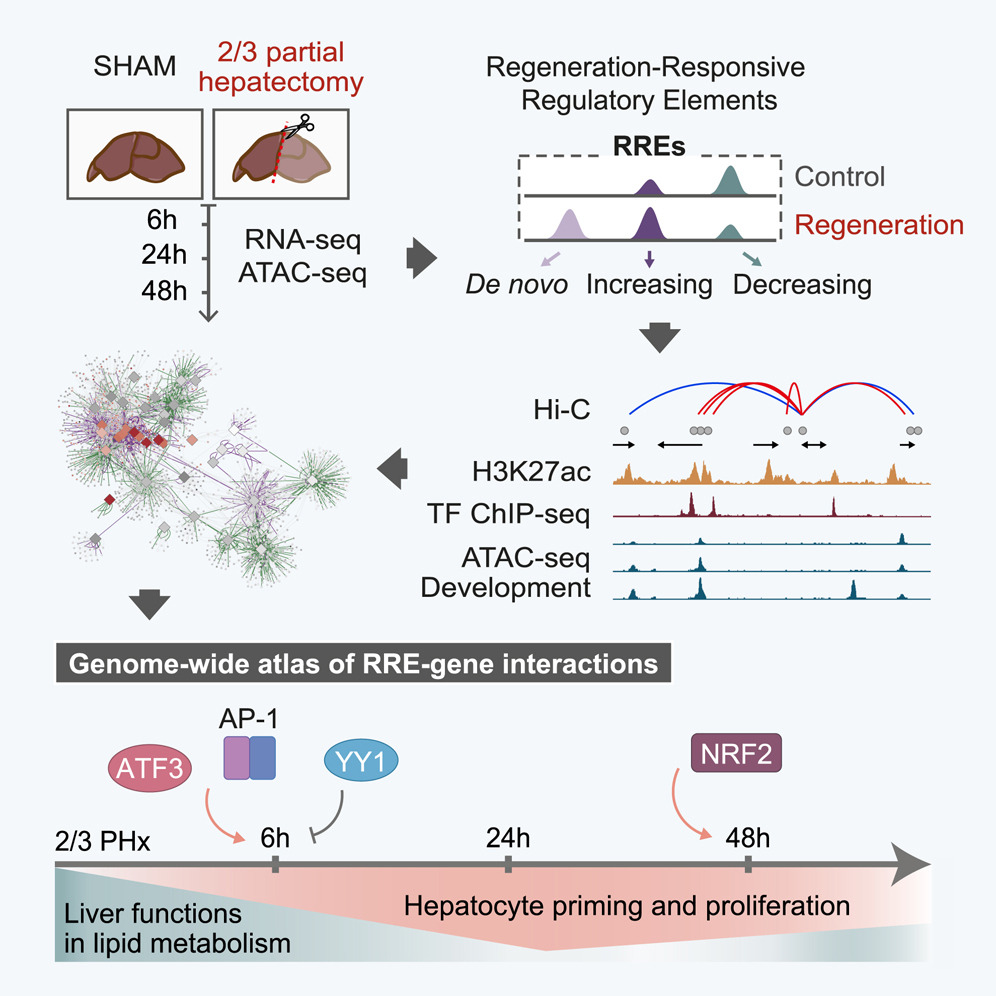
The study found that during liver regeneration, the expression of key genes is regulated by multiple cis-regulatory elements, including regeneration-specific enhancers and reactivated developmental enhancers. These enhancers promote hepatocyte activation and proliferation by activating transcription factors. Specifically, the AP-1 complex and ATF3 activate enhancers at the early regeneration stage, while NRF2 plays a dominant role during the proliferation phase. These transcription factors regulate gene expression by binding to specific DNA sequences, thus driving liver regeneration.
Additionally, the researchers discovered that during regeneration, some enhancers regulating liver-specific metabolic functions are suppressed, especially those involved in lipid metabolism. This suppression helps prioritize proliferation programs by temporarily inhibiting energy-intensive metabolic processes, such as bile acid and retinoid synthesis. This regulatory mechanism reveals the dynamic changes in gene expression during regeneration and provides new insights into the molecular mechanisms of liver regeneration.
A highlight of this research is the provision of a genome-wide map of enhancer-gene interactions during liver regeneration, revealing the cooperative mechanisms of regeneration-specific and developmental enhancers. These findings not only deepen our understanding of the molecular mechanisms of liver regeneration but also offer valuable resources for future regenerative medicine research. For example, by activating specific enhancers or modulating transcription factor activity, drugs could be developed to promote liver regeneration, providing new strategies for treating liver diseases.
Although this study is fundamental research without direct clinical application yet, its potential impact on regenerative medicine is significant. In summary, this study opens new avenues for regenerative medicine development by revealing the key gene regulatory mechanisms of liver regeneration. These findings enhance our understanding of the liver's remarkable regenerative ability and offer new hope for future medical breakthroughs.
Palmira Llorens-Giralt, Marina Ruiz-Romero, Ramil Nurtdinov, et al. Sequential activation of transcription factors promotes liver regeneration through specific and developmental enhancers, Cell Genomics (2025). DOI: 10.1016/j.xgen.2025.100887.
https://www.sciencedirect.com/science/article/pii/S2666979X25001430
 |
 |
 |

