On May 1, Eli Lilly released its Q1 2025 financial report. The total revenue was $12.729 billion, representing a 45% year-on-year growth. Revenue in China reached $451 million, an increase of 20%. R&D expenses totaled $2.73 billion, up 8%, accounting for 21.5% of total revenue.
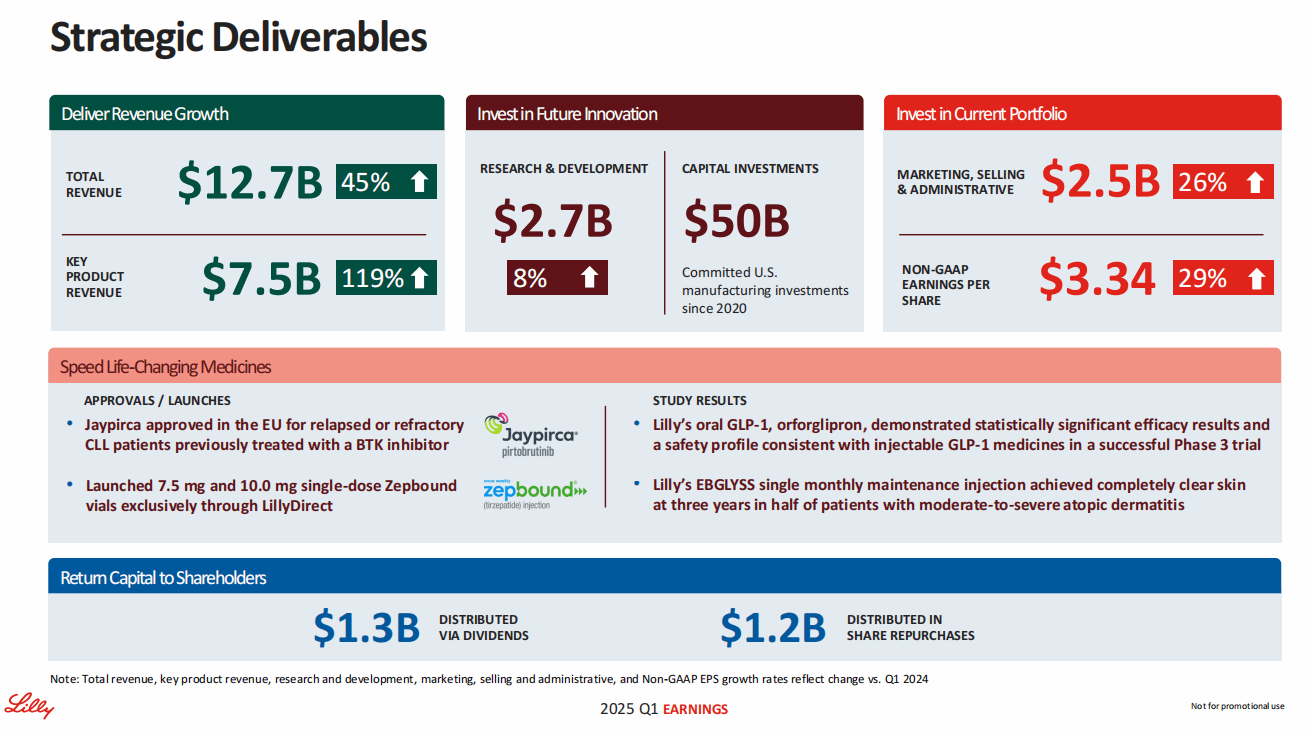
Eli Lilly defines its core products as Ebglyss, Jaypirca, Kisunla, Mounjaro, Omvoh, Verzenio, and Zepbound. The combined Q1 revenue for these products reached $7.52 billion (+119%), driven mainly by the sales growth of Mounjaro and Zepbound.
Mounjaro's global revenue reached $3.84 billion (+113%), with U.S. revenue at $2.66 billion (+75%). Its total prescription volume (TRx) accounted for 39%, while the new prescription volume (NBRx) made up 46%. Zepbound's U.S. sales reached $2.31 billion, with total prescription volume exceeding 60%, and new prescription volume accounting for 74%.

Overall, by the end of Q1 2025, Eli Lilly held a leading position in the U.S. GLP-1 insulin analog market, with its total prescription volume share increasing to 53.3%, surpassing its competitor Novo Nordisk. Currently, Eli Lilly has exclusively launched 7.5mg and 10.0mg single-dose vials of Zepbound through its LillyDirect online medical platform, which is expected to further expand the market.
Additionally, Verzenio, a CDK4/6 inhibitor used for the treatment of breast cancer, generated $1.26 billion (+18%), with its total prescription volume in the U.S. accounting for 43%. Jaypirca generated $92 million in revenue and received regulatory approval in the EU for the treatment of relapsed or refractory CLL after BTK inhibitor treatment. Ebglyss generated $60 million, and Kisunla generated $21 million. The IL-23p19 monoclonal antibody mirikizumab (Omvoh) was approved by the FDA for the treatment of moderate-to-severe active Crohn's disease in adults.

In terms of clinical research, Eli Lilly made significant progress. The Phase III ACHIEVE-1 study of the oral small-molecule GLP-1R agonist Orforglipron achieved positive results, showing a better A1C reduction compared to the placebo at 40 weeks. The average A1C was reduced by 1.3% to 1.6% from a baseline of 8.0%, and the overall safety was consistent with other established GLP-1 class drugs.
The Phase II ALPACA study of the siRNA therapy Lepodisiran achieved positive results, with Lepodisiran reducing Lp(a) levels by nearly 94% from baseline in adults with elevated Lp(a) levels, meeting the primary endpoint. Baricitinib showed positive data in the Phase III BRAVE-AA-PEDS study for the treatment of adolescent alopecia areata.
On the regulatory side, Jaypirca (pirtobrutinib) received a recommendation for approval from the European Medicines Agency (EMA) Human Medicines Committee (CHMP) for the treatment of relapsed or refractory chronic lymphocytic leukemia (CLL). The CHMP did not recommend approval of donanemab for the treatment of early Alzheimer's disease, and Eli Lilly will seek a re-evaluation.
Furthermore, Eli Lilly has completed the acquisition of Scorpion Therapeutics' small-molecule PI3Kα inhibitor STX-478, which is currently being evaluated in Phase I/II clinical trials for breast cancer and other advanced solid tumors.

Eli Lilly expects multiple Phase III clinical trials and regulatory developments in 2025, with full-year revenue guidance ranging between $58 billion and $61 billion.

