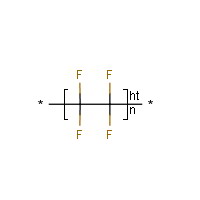
Tetrafluoroethylene (TFE), also recognized as perfluoroethylene, is a colorless, flammable, and toxic gas. It serves as the monomer for polytetrafluoroethylene (PTFE), commercially known as Teflon under the DuPont tradename. TFE undergoes copolymerization with various compounds to yield diverse Teflon products. The synthesis of TFE involves heating chlorodifluoromethane (CHClF2, Freon-22) or trifluoromethane (CHF3, Freon-23). Predominantly, TFE is utilized as a monomer in PTFE production, employing free radical polymerization.
The inadvertent discovery of polymerized TFE occurred in 1938 by DuPont researchers. During the mid-1930s, DuPont, in collaboration with General Motors, established Kinetic Chemicals for research on new chlorofluorocarbons (CFCs) for refrigerants. Roy J. Plunkett, a chemist assigned to the project, observed TFE polymerization while investigating CFCs. The subsequent examination of this substance, leading to the discovery of PTFE's unique properties, resulted in Plunkett applying for a patent in 1939, assigned to Kinetic Chemicals, which was later registered as Teflon by DuPont in 1945.
PTFE's distinctive physical attributes stem from its chemical structure, featuring long carbon chains enveloped by fluorine atoms. The fluorine atoms form a protective barrier, rendering PTFE resistant to chemical attacks and preventing adhesion. PTFE exhibits low coefficients of friction (< 0.1), owing to robust fluorine-to-carbon bonds and high electronegativity of fluorine, rendering PTFE highly stable. The densely packed crystalline solid structure of PTFE arises from the close arrangement of its long chains.
Although renowned for its use in cookware, Teflon's origins lie in industrial applications such as gaskets, sealers, tape, and electrical insulation during World War II. Marc Grégoire, a French inventor, played a pivotal role in introducing Teflon to cookware, coating his fishing gear initially. His success led to the formation of Tefal in 1956, marking the inception of Teflon-coated cookware. The introduction of Teflon cookware in the United States was championed by Thomas G. Hardie, establishing T-fal, with FDA approval granted in 1962.
Despite Teflon's success, concerns have arisen regarding the safety of its use, particularly related to workers producing Teflon and public use of Teflon cookware. Perfluorooctanoic acid (PFOA), used during PTFE polymerization, has raised health concerns, with lawsuits alleging health risks. In response, DuPont and cookware manufacturers plan to phase out PFOA in Teflon production.
Beyond cookware, PTFE finds diverse applications, including inks, plastics, coatings, lubricants, gaskets, seals, bearings, gears, films, tapes, rainproof garments, and the creation of Gore-Tex, a PTFE material developed by Wilbert Gore and Genevieve Gore in 1958.
Richard L. Myers (2009). The 100 Most Important Chemical Compounds: A Reference Guide. Greenwood Publishing Group. October 1, 2009. https://doi.org/10.1021/ed086p1182
|



 2YRS
2YRS