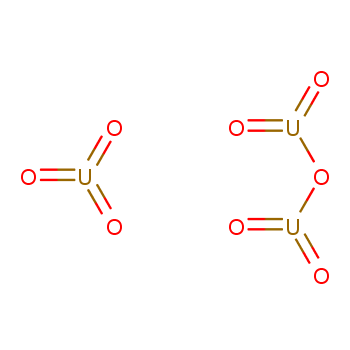
Uranium exists naturally as a mixture of various uranium oxides, with triuranium octaoxide (U3O8) being the most prevalent and stable chemical form. Uranium dioxide (UO2) and uranium trioxide (UO3) are also commonly found in uranium ores. Triuranium octaoxide, a complex oxide composed of U2O5 and UO3, is a dark-green to black solid primarily located in the mineral pitchblende. When uranium dioxide oxidizes, it produces U3O8 in a chemical reaction represented as: 3UO2 + O2 → U3O8. Additionally, uranium trioxide, upon heating above 500°C, is reduced to U3O8: 6UO3 → 2U3O8 + O2. The structural composition of U3O8 is pentagonal bipyramidal, featuring repeating UO7 units.
Uranium is renowned for its use as a nuclear power plant fuel, involving the extraction and enrichment of uranium from ores. The process initiates with mining uranium-rich ores, followed by rock crushing, slurry formation, sulfuric acid treatment, and subsequent reactions yielding ammonium diuranate ((NH4)2U2O7). Further heating results in yellow cake, an enriched uranium oxide containing 70–90% U3O8 in the form of UO2 and UO3 mixture. Yellow cake is transported to conversion plants for enrichment. Given that natural uranium consists of different isotopes, with 0.7% U-235 and 99.3% U-238, enrichment is crucial for nuclear reactor fuel (4% concentration) or weapons-grade uranium (90% concentration). The enrichment process involves dissolving yellow cake in nitric acid to produce uranyl nitrate hexahydrate (UO2(NO3)2?6H2O), purifying the solution, and heating to extract UO2, which is then reduced to UO with H2: UO2(NO3)2?6H2O+H2→UO2+2HNO3+6H2O
To further enrich uranium, the solid uranium oxide undergoes fluorination, converting it into a gaseous phase by reacting with hydrogen fluoride: UO2 + 4HF → UF4 + 4H2O. Uranium tetrafluoride (UF4) is combined with fluorine gas to produce uranium hexafluoride (UF6): UF4 + F2 → UF6. Uranium hexafluoride, a white crystalline solid under standard conditions, sublimes to a gas at 57°C. The enrichment of U-235 in uranium hexafluoride can be achieved through methods such as gaseous diffusion and gas centrifuge, leveraging the difference in masses between uranium isotopes.
Enriched UF6 undergoes processing at fuel fabrication facilities to produce UO2 powder through various methods. In one such process, uranium hexafluoride is vaporized and subsequently absorbed by water, resulting in the formation of uranyl fluoride (UO2F2) solution. Ammonium hydroxide is introduced to this solution, leading to the precipitation of ammonium diuranate. Following drying, reduction, and milling, uranium dioxide powder is produced. This powder is then compressed into fuel pellets for utilization in nuclear reactors.
Conventional nuclear power entails harnessing the heat generated in a controlled fission reaction to generate electricity. The reactor core, enclosed in a heavy-walled reaction vessel, houses fuel elements consisting of zirconium rods filled with UO2 pellets. Water fills the reactor for cooling purposes and serves as a moderator, slowing down neutrons to enhance the likelihood of neutron interaction with uranium for fission. Control rods, composed of cadmium and boron, are interspersed among the fuel rods to manage the nuclear reaction by absorbing neutrons.

While the fundamental design of most nuclear reactors is similar, diverse reactor types are employed worldwide. In the United States, the majority of reactors use plain water as the coolant, classifying them as light water reactors. These reactors can be pressurized to about 150 atmospheres, maintaining the primary coolant in the liquid phase at temperatures around 300°C. The pressurized water's heat is utilized to raise the temperature of secondary water, producing steam for electricity generation. Boiling water reactors permit water in the core to boil directly, and the resulting steam powers turbines. Heavy water reactors, using D2O as the coolant and moderator, employ deuterium (D or 2H) as the hydrogen isotope, allowing the use of natural uranium instead of enriched uranium as fuel.
Breeder reactors were developed to utilize the non-fissile U-238, constituting 97% of natural uranium. The concept behind breeder reactors is to convert U-238 into a fissile fuel material. A reaction to breed plutonium is:

The behavior of plutonium fuel in a breeder reactor differs from that of uranium. Plutonium necessitates fast neutrons for fission, precluding the use of water as a moderator in breeder reactors. Liquid sodium is commonly employed in breeder reactors, leading to the designation "liquid metal fast breeder reactor" (LMFBR). The controversy surrounding breeder reactors is linked to concerns about the production of weapon-grade plutonium and the proliferation of nuclear arms.
Richard L. Myers (2009). The 100 Most Important Chemical Compounds: A Reference Guide. Greenwood Publishing Group. October 1, 2009. https://doi.org/10.1021/ed086p1182
|