In the French Alps, the winding roads slowly climb to an altitude of 1,200 meters, where a picturesque village named Montchavin is located. This once-sleepy mountain village became a popular ski resort in the 1970s, and the world’s largest ski area, Paradiski, is situated here. However, Montchavin has also attracted the attention of medical researchers, not due to skiing or mountaineering accidents, but because of a rare disease that has “frequently occurred” here.

Montchavin
On a day in 2009, neurologist Emmeline Lagrange saw a special patient. She was in her thirties, from Poland, and worked as a ski instructor and lift ticket collector during the ski season, while working at the local tourism office in the off-season. She was suffering from an unexplained disease, which was later diagnosed as amyotrophic lateral sclerosis (ALS), commonly known as “Lou Gehrig's Disease” or “motor neurone disease.” This was the fourth case of ALS in the village. A local doctor’s neighbor had died of ALS 20 years ago, and the doctor still had two friends who were battling the disease.

Emmeline Lagrange
Previously, the “Ice Bucket Challenge” on social media raised awareness of this rare disease. ALS is a devastating neurological condition caused by the gradual loss of nerve function in the motor neurons of the brain, spinal cord, limbs, and chest muscles. Symptoms typically begin with muscle twitching and weakness in the arms or legs, difficulty swallowing, or slurred speech. As the disease progresses, patients experience increasing difficulty in performing tasks that were once easy, with muscle weakness and atrophy. It’s as if the body loses its source of strength, and the limbs become stiff, as though being slowly frozen by an invisible “ice.” Ultimately, ALS affects the muscles needed for movement, speech, eating, and breathing, leading to difficulty breathing and malnutrition, and many patients eventually die from respiratory failure.

ALS ice bucket challenge
Currently, there is no cure for this fatal disease, and its exact cause remains unclear. Only a small number of cases are genetic. Worldwide, ALS is rare and evenly distributed, with only two to three cases occurring per 100,000 people each year.
Montchavin is crowded with tourists during the travel season, but its year-round population is only a few hundred people. The nearby villages are also small, and based on the incidence rate mentioned above, the likelihood of finding ALS patients here is extremely low. However, in fact, over the course of several years, Lagrange diagnosed 16 cases of ALS in the local area. This surprisingly high number of cases completely shocked her, and she recalled feeling increasingly fearful as the number of cases grew.
So, why are there so many ALS patients in this small village?
In the field of medicine, ALS has always been a difficult problem to solve. The cause of ALS for most patients remains a mystery, with only 5% to 10% of patients showing signs of genetic inheritance. Among those with genetic ALS, there is a 50% chance that their children will inherit the disease-related genes. Additionally, medical researchers have found that exposure to cigarette smoke, air pollution, and some industrial chemicals is associated with an increased risk of ALS. Several studies have shown that U.S. veterans have a higher risk of developing ALS than non-veterans, possibly due to specific military duties (such as exposure to neurotoxins) during their service. However, the exact causal relationship has not been determined.
Lagrange, along with tropical neuroepidemiologist Philippe Couratier and neurologist William Camu, formed a team to investigate the cluster of ALS cases in Montchavin. Between 1991 and 2013, the village reported five cases of ALS; between 2010 and 2015, another seven cases were discovered. But not all of these patients had lived there long-term. Most patients had lived in Montchavin for at least ten years; some were locals, while others were seasonal residents from various countries, including France, Poland, Turkey, Canada, and the UK. Even more surprisingly, there was a couple where both the husband and wife developed ALS. The husband, a local, worked as a ski instructor during the season and a lumberjack in the off-season. In 2005, the husband was diagnosed with ALS at the age of 63, and eight years later, his wife was diagnosed with the same disease.
However, in these 12 patients, no genetic or familial connection was found. Blood tests revealed that none of them carried the genetic markers associated with ALS, effectively ruling out hereditary causes.
To find the real culprit, Lagrange and her team decided to investigate environmental factors. They acted like detectives, leaving no potential clue unchecked: testing the village's drinking water and garden soil for toxic substances, checking the snowmaking machines on the ski slopes, and considering the presence of a long-abandoned lead mine nearby, testing for lead levels and radon in the patients' homes (radon is a radioactive gas that emanates from soil and rocks).
The search for the cause was a challenging and foggy process, but researchers could not find any single, obvious environmental factor that could be linked to all the patients. After eight years of investigation, they compiled their findings into a paper, leaving the academic world with a mystery. At the time, the academic community considered the ALS cases in Montchavin to be a random phenomenon. Lagrange said in an interview: “We reached a standstill; we had no more tricks up our sleeve.”
Lagrange’s research partner, neurologist William Camu, discussed their findings at a 2017 academic conference in Strasbourg, France, with ALS expert Peter Spencer.
Lagrange and Camu submitted an abstract of their research, which stated, “A common factor was found among the 12 patients: with the exception of one, all had engaged in intense physical activity; eight owned vegetable gardens; six had eaten local mushrooms; five were ski instructors, and four had a restaurant.” Spencer recalled, “I noticed that mushrooms were mentioned. I asked which type of mushroom it was, because there is a type of mushroom that contains toxins related to the Chamorro disease in Guam.”
At the end of World War II, American medical researchers discovered a rare neurodegenerative disease with high incidence among the native Chamorro people of Guam. The disease initially resembled ALS but also displayed symptoms of Parkinson’s disease and dementia, referred to as Lytico-bodig disease (the first part refers to ALS, while the second part refers to Parkinson’s and dementia, with some patients exhibiting all symptoms). During the 1950s-1970s, the disease was severe, and according to a 1954 report, the ALS incidence rate was 100 times higher than the global average. Eventually, in 1961, the disease was named the Amyotrophic Lateral Sclerosis-Parkinsonism-Dementia Complex (ALS-PDC).
At that time, the U.S. National Institutes of Health set up a research station on the island to investigate the cause. Due to the familial links, researchers initially focused on genetic causes, but, just like in the French Alps, the disease also affected immigrants, leading them to focus on environmental factors.

Cycas micronesica
Among various hypotheses, the Cycas hypothesis, proposed by anthropologist Marjorie Whiting in 1963, became the most supported theory. The Chamorro people had a unique way of preparing food using cycas seeds, which are toxic but can be detoxified by soaking and changing water several times. However, this method may not remove all the toxins, leading to danger. Unfortunately, animal experiments did not confirm that cycas seeds could cause ALS-PDC, and the hypothesis eventually faded. Other environmental factors, such as soil metals and viruses, were also thoroughly investigated but could not establish a causal relationship. Thus, the search for the cause of ALS-PDC remained full of fog, with ongoing debates.

Cycas tree (top left image) and Cycas seeds (bottom left image), as well as the traditional processing method of the Moro people.
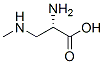
However, one person did not give up on the Cycas hypothesis—Peter Spencer. In the 1980s, he discovered that a toxin called β-N-methylamino-L-alanine (BMAA) in cycas seeds could lead to ALS-PDC. Unfortunately, the amount of toxin required for this experiment was much higher than the Chamorro people’s dietary habits, and his discovery was not given much attention. Over the past 40 years, Spencer and his colleagues have continued to research this issue, and new clues have emerged.
In 2019, Spencer published research in *Frontiers in Neurology* showing that another neurotoxin found in cycas seeds, called Cycasin, may be related to the onset of ALS. An enzyme in the human body converts Cycasin into methylazoxymethanol (MAM), and MAM causes DNA methylation, inducing cell mutations, particularly in the degenerative changes of neurons. Although the body also has enzymes capable of repairing DNA damage, Spencer presented a new perspective: "The levels of this important DNA repair enzyme in the adult brain are usually very low. DNA damage accumulates and activates cellular signaling pathways associated with neurodegenerative diseases in humans." [7]
In other words, Cycasin destroys DNA, which is similar to chemical carcinogenesis. The human body also methylates DNA when metabolizing nitrosamines and hydrazine compounds, leading to the accumulation of DNA damage, which eventually causes cancer. Since neurons do not divide, this can eventually lead to diseases like ALS-PDC. The similarity in mechanisms offers new insights into related research.
So, could the ALS cases in the French mountain village be due to toxins in mushrooms?
Lagrange collaborated with Spencer and conducted a new investigation in the Alps. She discovered that all of the patients had eaten a species of false morel. There are many types of false morel mushrooms, but the most famous and toxic is the *Gyromitra esculenta*, which happens to be one of the types of mushrooms collected and consumed by Montchavin ALS patients. These false morels are commonly found in forests across Europe, Asia, and North America during spring.
The false morel has a distinctive appearance, with a cap that resembles an irregular brain shape (which is why it is sometimes called "brain mushroom"). The surface is covered with folds and comes in various colors, including reddish-brown, purple-brown, gold-brown, and coffee brown. The edges of the cap are not connected to the stem, making it appear as though the cap is precariously hanging. In contrast, the true morel (*Morchella esculenta*) has a cone-shaped cap with many neat indentations, resembling the belly of a sheep (hence the name), and the edges of the cap are firmly attached to the stem, making it more stable.


Morchella esculenta Gyromitra esculenta
Both the true morel and the false morel are delicious. The fact that both have "esculenta" in their species name, meaning "edible" in Latin, indicates their popularity. Ironically, people have long known that false morels are toxic, but they still take the risk and try to boil or dry them in hopes of removing the toxins. A study published in *Toxicon* in June 2024 recorded 118 cases of false morel poisoning from 2002 to 2020. In 90% of these cases, the culprit was *Gyromitra esculenta*. The most common symptoms of poisoning included vomiting, diarrhea, and stomach pain; several cases involved liver damage, one involved kidney damage, and other patients reported neurological symptoms like headaches and dizziness. [8]

Different countries have different policies on the sale of fake morels, with France and Denmark banning them, while Finland allows them. The Finns love mushrooms, and they’ve even been featured on stamps.
Through their research, Lagrange and her colleagues learned that the ALS patients believed false morels had "restorative" properties and enjoyed their taste, so they deliberately sought out and ate these mushrooms. They were aware that France prohibits the sale of false morels, so they formed secret small groups to forage for and eat mushrooms. Indeed, half of the French ALS patients experienced acute poisoning after eating false morels.
So, was the link between eating false morels and ALS just a coincidence, or is there a causal relationship? To rule out other environmental factors, the researchers set up a control group of 48 people from the same region, roughly the same age as the patients, and had them eat wild mushrooms but not false morels. The conclusion was that no other significant chemical or physical exposures were found, and the primary risk factor for ALS in the area seemed to be the repeated consumption of these neurotoxic fungi. The researchers wrote in their paper: "This was the key factor distinguishing ALS patients from the control group residents." [9]
A series of studies have shown that eating mushrooms containing toxins that damage DNA is not wise. Excessive intake of neurotoxic metals/metalloids is widely recognized for its harmful health effects. The growth of plants and mushrooms naturally bioaccumulates metals and metalloids from the soil and water, leading to high concentrations of potentially neurotoxic elements in both cultivated and wild species used as food. [10]
As early as 1968, scientists extracted the main toxin, gyromitrin, from *Gyromitra esculenta*, which is also a carcinogen. In the human body, gyromitrin can be converted into monomethylhydrazine (MMH), which can cross the blood-brain barrier and damage DNA. In fact, this substance is used as a highly efficient fuel propellant in aerospace applications.

Metabolic pathway from gyrophorin to methylhydrazine
Spencer believes that there are similarities between the frequent ALS cases in Guam and Montchavin: both groups of patients consumed natural food containing toxins, and these toxins are potentially related to hydrazine compounds. Spencer and his colleagues' studies support this view. They have found hydrazine-related chemicals with carcinogenic and neurotoxic potential in certain mushrooms, plants, and even industrial products in aerospace fields. These chemicals induce DNA damage (mainly O6-, N7-, and 8-oxo-guanine damage), leading to multiple downstream effects associated with cancer and neurological diseases. Unrepaired DNA damage leads to mutations and uncontrolled mitosis. After mitosis, neurons attempt to re-enter the cell cycle but undergo apoptosis or non-apoptotic cell death.

The role of hydrazine-related chemicals in cancer and neurodegenerative diseases
Mycologist Alden Dirks of the University of Michigan and his colleagues conducted in-depth research on mushrooms containing gyromitrin, and it was he who identified the false morel consumed by the French patients. In their paper, they wrote: "Exposure to gyromitrin presents covert chronic toxicity, potentially linked to neurodegenerative diseases. An increasing amount of literature has raised concerns in this regard. Further research is needed to clarify the nature of these associations." [8]
However, some researchers remain skeptical of Lagrange and her team's findings. Jeffrey D. Rothstein, a neuroscientist at Johns Hopkins University School of Medicine, believes the cluster of ALS cases in Montchavin is coincidental. He pointed out that other clusters of ALS cases in the past have been proven to be random. In his view, while the cycas hypothesis has some merit, more research is still needed on the French case.
Evelyn Talbott, an environmental epidemiologist at the University of Pittsburgh School of Public Health, finds the theory of neurotoxins causing ALS convincing. She said: "The fact that both the husband and wife ate false morels and both developed ALS is truly shocking, because ALS cases in married couples are extremely rare."
Although a link has been found between false morels and ALS, there are still many limitations in the current research, and many key questions remain to be answered. For example, knowing that false morels contain toxins and that some patients have consumed them is not enough to fully explain the specific molecular mechanisms by which these toxins trigger ALS in the human body.
Lagrange admits that as a clinical neurologist, she does not have the capacity to conduct cell culture, animal modeling, and genetic research, which could push the study to new heights. However, her colleague Camu has already begun testing their hypothesis in laboratory mice.
On a hopeful note, after Lagrange's investigation, no new cases have occurred. Additionally, ALS-PDC cases on Guam have nearly disappeared since the 1980s. This seems to point the finger at those things that should not be eaten.
[1] https://www.mayoclinic.org/diseases-conditions/amyotrophic-lateral-sclerosis/symptoms-causes/syc-20354022
[2] Re, Diane B et al. “A perspective on persistent toxicants in veterans and amyotrophic lateral sclerosis: identifying exposures determining higher ALS risk.” Journal of neurology vol. 269,5 (2022): 2359-2377. doi:10.1007/s00415-021-10928-5[3] McKay, Kyla A et al. “Military service and related risk factors for amyotrophic lateral sclerosis.” Acta neurologica Scandinavica vol. 143,1 (2021): 39-50. doi:10.1111/ane.13345
[4] E Lagrange, Vincent Bonneterre, K Talbot, Philippe Couratier, E Bernard, et al.. A high-incidence cluster of ALS in the French Alps: common environment and multiple exposures. 28th international symposium on ALS/MND, Dec 2017, Boston, United States. 18 (Supplément S2), pp.179, 2017, Amyotrophic Lateral Sclerosis and Frontotemporal Degeneration. ?hal-01658408?
[5] https://www.pennmedicine.org/news/publications-and-special-projects/penn-medicine-magazine/archived-issues/2017/winter-2017/guam
[6] Steele, John C., and Patrick L. McGeer. "The ALS/PDC syndrome of Guam and the cycad hypothesis." Neurology 70.21 (2008): 1984-1990.
[7] Spencer PS. Hypothesis: Etiologic and Molecular Mechanistic Leads for Sporadic Neurodegenerative Diseases Based on Experience With Western Pacific ALS/PDC. Front Neurol. 2019;10:754. Published 2019 Jul 31. doi:10.3389/fneur.2019.00754
[8] Vohra V, Dirks A, Bonito G, James T, Carroll DK. A 19-year longitudinal assessment of gyromitrin-containing (Gyromitra spp.) mushroom poisonings in Michigan. Toxicon. 2024;247:107825. doi:10.1016/j.toxicon.2024.107825
[9] Lagrange E, Vernoux JP, Reis J, Palmer V, Camu W, Spencer PS. An amyotrophic lateral sclerosis hot spot in the French Alps associated with genotoxic fungi. J Neurol Sci. 2021;427:117558. doi:10.1016/j.jns.2021.117558.
[10] Spencer PS, Palmer VS. Direct and Indirect Neurotoxic Potential of Metal/Metalloids in Plants and Fungi Used for Food, Dietary Supplements, and Herbal Medicine. Toxics. 2021;9(3):57. Published 2021 Mar 16. doi:10.3390/toxics9030057
[11]. Spencer PS, Palmer VS, Kisby GE, et al. Early-onset, conjugal, twin-discordant, and clusters of sporadic ALS: Pathway to discovery of etiology via lifetime exposome research. Front Neurosci. 2023;17:1005096. Published 2023 Feb 13. doi:10.3389/fnins.2023.1005096
[12]. Spencer PS, Kisby GE. Role of Hydrazine-Related Chemicals in Cancer and Neurodegenerative Disease. Chem Res Toxicol. 2021;34(9):1953-1969. doi:10.1021/acs.chemrestox.1c00150
|


 6YRS
6YRS