2',3'-dideoxyadenosine is a molecule that mimics the structure of natural DNA and RNA building blocks. This unique property makes ddA a valuable tool in research. Scientists can utilize ddA to study various biological processes by incorporating it into cells and observing its effects. Interestingly, ddA can also serve as an inhibitor of adenylyl cyclase, an enzyme involved in cellular signaling. This article delves into the world of ddA, exploring its potential and unlocking new insights in research!
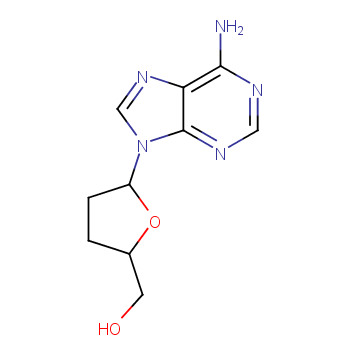
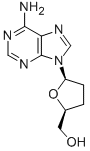
2',3'-Dideoxyadenosine (ddA) possesses a unique structure that forms the basis of its functional properties, depicted in the nucleoside 2,3-dideoxyadenosine structural formula (see figure below). It shares many similarities with the naturally occurring molecule adenosine, which is a component of RNA. Both have a core structure consisting of a fused purine ring system linked to a ribose. However, a key difference lies in the position of the hydroxyl groups.

The figure shows the positions of the purine ring, ribose, and carbons 2' and 3', where hydroxyl groups are absent. The critical distinction between ddA and adenosine is that in ddA, there are no hydroxyl groups (OH) at the 2' and 3' positions of the ribose. In adenosine, these hydroxyl groups are present, aiding in the formation of phosphodiester bonds crucial for building RNA chains. The absence of these hydroxyl groups in ddA disrupts this process, making it a valuable tool in DNA sequencing technologies.
Dideoxynucleotides are used in DNA sequencing and electrophoresis. DNA samples undergoing PCR (polymerase chain reaction) with a mixture containing all four deoxynucleotides and one dideoxynucleotide will produce chains of lengths corresponding to each base position where that particular type of nucleotide is complementary to the dideoxynucleotide. Taq polymerase used in PCR favors ddNTP incorporation, a pattern observed in various studies. That is, each specific type of nucleotide base has the possibility to bind not with a deoxynucleotide but with a dideoxynucleotide, thus terminating chain elongation. During DNA replication, DNA binds to the growing DNA chain but lacks the 3'-hydroxyl necessary to add the next nucleotide. This "chain termination" prevents further extension, resulting in fragments of specific lengths. When these fragments are separated by size, they reveal the DNA sequence.
Therefore, if samples are subsequently subjected to electrophoresis, a band will be present for each length where a dideoxynucleotide complement exists. Fluorescent dideoxynucleotides are commonly used nowadays, with each of the four having different fluorescence that can be detected by a sequencer.
Cellular communication heavily relies on a molecule called cyclic AMP (cAMP). Adenylyl cyclase plays a crucial role in regulating cAMP levels. Here's where ddA intervenes:
(1) Inhibition of Adenylyl Cyclase: ddA acts as a specific inhibitor of adenylyl cyclase, effectively reducing the production of cAMP.
(2) Impact on Biological Processes: By controlling cAMP levels, ddA can influence various cellular processes such as cell growth, differentiation, and hormone action. Studying these effects helps researchers understand the intricate workings of the cAMP signaling pathway.
The potential of ddA extends beyond DNA sequencing and cAMP regulation. Researchers are exploring its applications in:
Signaling Pathways: ddA can serve as a valuable tool for dissecting complex intracellular signaling cascades, aiding in the development of targeted therapies for various diseases.
With its unique characteristics, ddA holds promise as a powerful research tool, offering exciting possibilities for unraveling the mysteries of DNA and cell communication.
High-quality 2',3'-dideoxyadenosine (ddA) can be obtained from reputable chemical suppliers. Chemical networks like Guideview can provide suitable suppliers based on your specific needs. When selecting a supplier, factors such as ddA purity should be considered, which is crucial for many research applications. Additionally, the quantity of ddA required for experiments will influence your choice, and bulk purchases may offer discounts.
Using ddA requires a commitment to safe and responsible practices. Literature emphasizes the importance of wearing appropriate personal protective equipment (PPE) when handling ddA, such as gloves, safety goggles, and lab coats, to minimize skin contact. Due to its potential respiratory irritation, using a fume hood is advisable when generating dust or aerosols. Always handle ddA in well-ventilated areas. Proper storage is also essential. Store ddA in a cool, dry place, away from heat, light, and incompatible chemicals. Following these preventive measures ensures a safe and effective research environment. Remember to consult relevant safety data sheets (SDS) for detailed disposal guidelines, as proper waste management is crucial for protecting human health and the environment.
2',3'-Dideoxyadenosine (ddA), as a potential biologically active molecule, holds significance in antiviral drug and biomedical research fields. Current research has revealed ddA's potential in DNA sequencing and anti-tumor effects, with further studies underway to unveil its broader applications. In the future, with the continuous advancement of scientific technology, ddA as an important biologically active molecule will demonstrate broader prospects in drug development and biomedical research, bringing positive impacts to human health and medical treatment.
[1]https://www.dshs.wa.gov/sites/default/files/DDA/dda/documents/policy/policy6.08.pdf
[2]https://www.sciencedirect.com/topics/pharmacology-toxicology-and-pharmaceutical-science/2-3-dideoxyadenosine
[3]https://pubchem.ncbi.nlm.nih.gov/compound/2_3_-Dideoxyadenosine
[4]https://en.wikipedia.org/wiki/Dideoxynucleotide
[5]https://www.sciencedirect.com/topics/medicine-and-dentistry/2-3-dideoxyadenosine
|


 15YRS
15YRS