During the peak flu season, children's hospitals are overcrowded. This article, based on prior literature research and relevant experience, provides an analysis of the "super anti-flu drug" Mabaloxavir dry suspension, hoping to inspire the readers.
Prior to the approval of Mabaloxavir, there were only two categories of anti-flu antiviral drugs available: one is the M2 blockers (Amantadine and Rimantadine), and the other is neuraminidase inhibitors (NAIs: Oseltamivir, Zanamivir, and Peramivir). Mabaloxavir is a prodrug that selectively inhibits cap-dependent endonuclease. It is the first and only antiviral flu drug with a new mechanism of action approved by the FDA in nearly 20 years. The drug is taken in a single oral dose, works quickly, is safer, and has better compliance. Its tablet form has been approved in many countries and regions for the treatment and post-exposure prevention of flu. The single-dose oral administration method is clinically recognized and more convenient compared to other flu treatment drugs on the market. Roche Pharma (Schweiz) AG applied for the import and marketing of Mabaloxavir dry suspension under Chemical Drug Category 5.1. The product, with a specification of 40mg/20mL (2mg/mL), is manufactured by Shionogi Pharma Co., Ltd., and packaged by F. Hoffmann-La Roche AG (Switzerland), with the registration agent being Roche (China) Investment Co., Ltd. The approval process followed the priority review procedure (for pediatric use), and it was approved by the National Medical Products Administration on December 29, 2023. The dry suspension is convenient for young children or patients who cannot swallow tablets. This product has been included in the "List of Clinically Needed Overseas New Drugs (Third Batch)."

Currently, there are no approved generic products, and the compound and product are still under patent protection. The following introduces the prescription and quality control of this product for guidance.
The product's commercial name is "Xofluza" and is known as "Super Tamiflu." The entire treatment only requires a single dose, which greatly improves patient compliance. Below is an introduction to the prescription process, based on the review reports published in Europe, the U.S., and China.
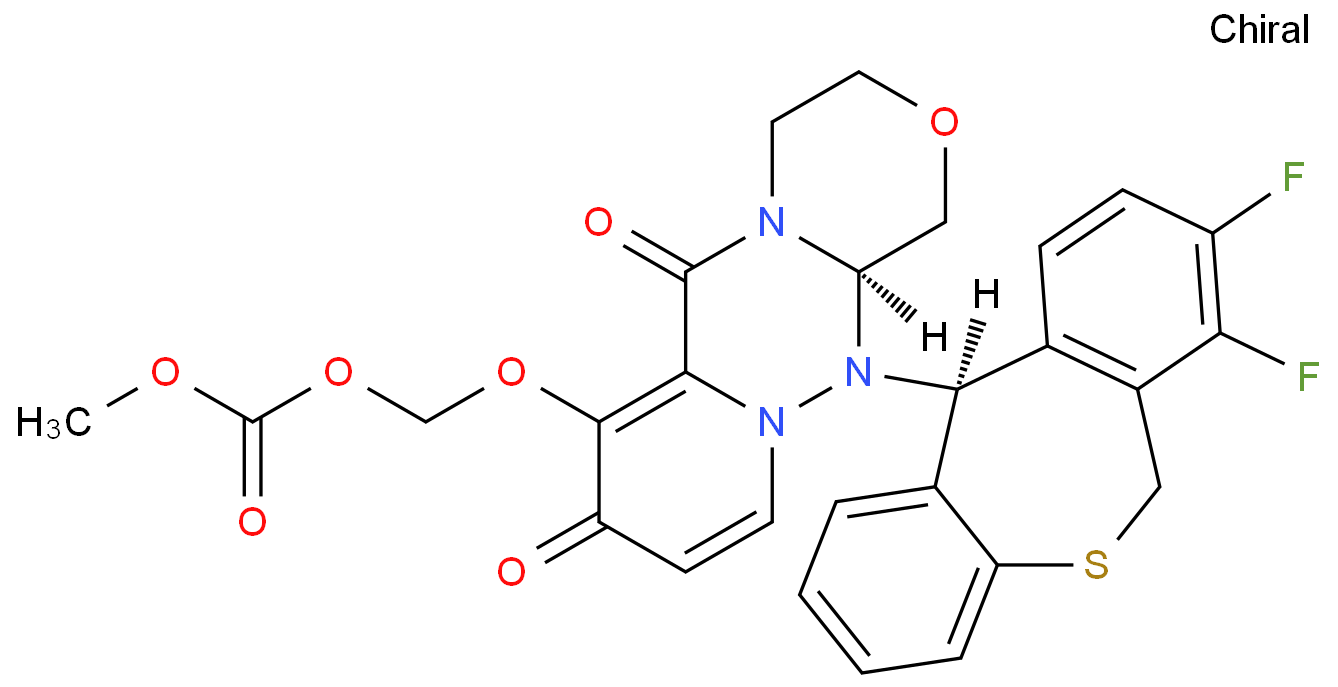
The active pharmaceutical ingredient, Mabaloxavir, has a molecular weight of 571.55, a logP value of 2.26, is soluble in dimethyl sulfoxide, soluble in acetonitrile, slightly soluble in methanol and ethanol, and almost insoluble in water. This API has poor solubility and its solubility is pH-independent. Generally, particle size needs to be controlled to ensure the product's dissolution rate meets the requirements. The API has two chiral centers, so attention should be paid to the chiral isomer situation.
The excipients in the dry suspension formulation include mannitol, maltitol, sodium chloride, hydroxypropyl methylcellulose, polyvinylpyrrolidone K25, sucralose, colloidal silicon dioxide, talc powder, and strawberry flavoring. Strawberry flavoring is used as a flavor mask to improve the oral compliance of children. The reasonable use of excipients should be carefully monitored, and potential small molecule aldehyde impurities in the strawberry flavor should be noted. The safety of the excipient quantities should be evaluated based on the maximum daily dose of 80mg. All excipient quantities should comply with relevant regulatory requirements (such as the FDA inactive ingredient database). Strawberry flavoring is an unapproved excipient, and toxicological data may be required to demonstrate its usage is safe.
The product is packaged in amber glass bottles with a child-resistant screw cap, with a single-dose packaging. The maximum daily dose is 80mg. The usage method requires the product to be dispersed in 20mL of water to prepare a suspension of 2mg/mL. The FDA review report shows that the product is subject to overfilling, which has been verified through extraction testing (ensuring a minimum extraction of 20mL).
The key quality attributes for the product, as reported in the FDA review, include: form (dry suspension and reconstituted suspension), identification, dry suspension content and content uniformity, reconstituted suspension content and content uniformity, related substances, dissolution, content uniformity, and microbial limits. The FDA review noted that the characteristics of the product changed during the review, particularly with respect to the reconstituted suspension, which is described as an opaque suspension ranging from gray-white to light yellow with a strawberry flavor, while the dry suspension is described as white to light yellow granules. The EMA review report listed the release standards and shelf life standards, including visual inspection of bottle contents, visual inspection of the reconstituted suspension, preparation time, dispersion uniformity (Ph. Eur.), identification (UHPLC, UV), content per bottle (HPLC), related substances (HPLC), moisture content (Ph. Eur.), dissolution (Ph. Eur., UV), dose uniformity (Ph. Eur., UHPLC), and microbial limits (Ph. Eur.). FDA and EMA quality control projects are mostly consistent.
Stability studies during use showed that the product formulation does not contain preservatives, and after preparation into a suspension, it can be stored at 20-25°C for up to 10 hours. The FDA review report confirmed that microorganisms began to appear in the suspension after 10 hours.
The dissolution details for this product, according to the FDA dissolution database, are as follows: the product is measured using paddle method at 25 rpm. The dissolution conditions should be able to differentiate between different particle sizes of the API, as dissolution behavior may vary depending on particle size.

The quality control limits and identification limits should meet ICH requirements.
Based on the maximum daily dose of 80mg, a reasonable control strategy should be established, complying with ICH Q3D requirements.
To prepare the suspension, gently tap the bottom of the bottle to loosen the drug particles. Dispense the dry suspension into 20mL of drinking water or sterile water. Slowly shake the bottle to evenly suspend the particles (do not shake the bottle vigorously, as this will generate foam and lead to inaccurate dose extraction). Ensure that the suspension is used within 10 hours. Compatibility and microbiological challenge testing should support the usage method for this suspension. This product is suitable for patients who cannot swallow or have difficulty swallowing, or it can be administered via a nasogastric tube. Use 1mL of water before and after administration. For nasogastric tube administration, the applicant must conduct in vitro comparative studies in accordance with relevant technical guidelines to support this method of administration.
The storage condition for the dry suspension is "tightly closed, not exceeding 25°C." The prepared suspension should be stored at 30°C or below and used within 2 hours after preparation. If the suspension is not used within 2 hours or if the exposed temperature exceeds 30°C, it should not be used. Corresponding stability data should be provided to support the proposed storage conditions.
The Mabaloxavir dry suspension is suitable for children and requires only a single dose, greatly improving patient compliance. The product is still under patent protection, and no generic products have been filed. This article, based on previous literature research, analyzes its formulation and quality, hoping to provide guidance for future generic drug filings.
[1] FDA
[2] EMA
|



 3YRS
3YRS


