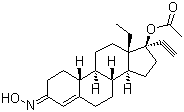
Norgestimate, marketed under brands such as Ortho Tri-Cyclen and Previfem, is a progestin medication used in female contraceptives and hormone replacement therapy. This medication is used in conjunction with estrogen and cannot be used alone. It is taken orally.
Patented in 1965, Norgestimate was introduced for medical use in 1986, particularly as a contraceptive. It was introduced in the U.S. for hormone therapy in 1999. Norgestimate is sometimes referred to as a “third-generation” progestin. It is widely available as a contraceptive around the world and is used for hormone therapy only in the U.S. and Brazil. Norgestimate can be used as a generic medication. In 2021, the ethinyl estradiol version was the 76th most prescribed drug in the U.S., with over 8 million prescriptions.
Choosing the right progestin for hormonal contraceptive measures is crucial for ensuring proper adherence. Existing synthetic progestins are typically classified into progestin and testosterone derivatives, as well as spironolactone analogs. The common ability of these “progestin” steroids is to bind with progesterone receptors (PR), with varying affinities to ensure the maturation of the endometrium modified by estrogen. However, the major differences between existing progestins lie in their pharmacological, pharmacokinetic, and pharmacodynamic properties, as well as their different capacities to interact with other intracellular steroid receptors. These progestins exhibit varying affinities for estrogen (ER), androgen (AR), glucocorticoid (GR), and mineralocorticoid (MR) receptors, demonstrating their potential agonistic or antagonistic effects. Such interactions may induce transcriptional activation or inhibit the activation of different steroid receptors, potentially leading to both positive and adverse effects. In other words, even if they belong to the same “progestin family,” they may display completely different clinical characteristics. Progestin products are continually updated, and new molecules are introduced, but some older molecules maintain unique advantages. In this broad panorama, Norgestimate represents a unique progestin due to its distinctive receptor activity as a testosterone derivative.
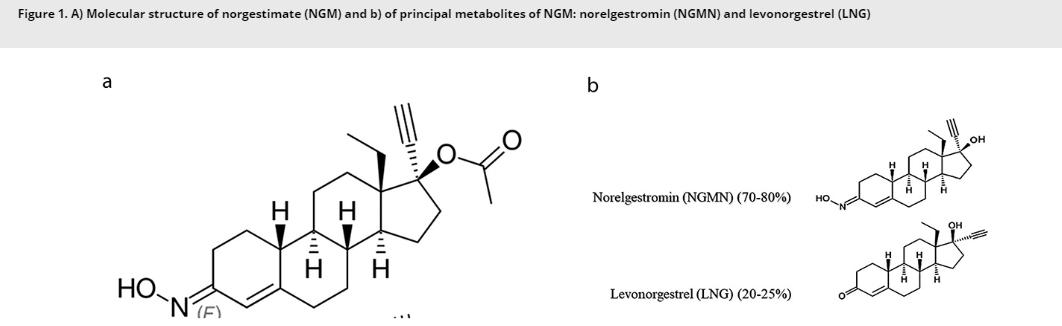
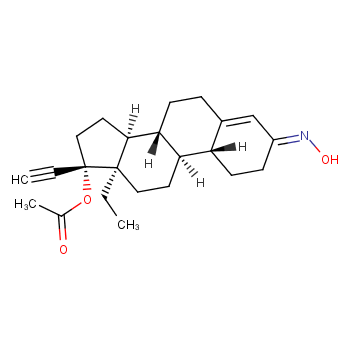
NGM (Figure 1a) is a 19-nortestosterone derivative of the gonane family. NGM is a 17-ethylated 18-methyl steroid, with an acetate at position 17 and an oxime at position 3 (Figure 1a). The C-17 acetate group as well as the unique C-3 oxime group inhibit its ability to bind to the AR. Since the C-3-keto group is a typical feature of androgenic compounds, its replacement with an oxime group may contribute to the reduction of the androgenicity of NGM compared to norgestimate (NGL) and levonorgestimate (LNG), in addition to other peripheral mechanisms that will be reported later.
Progestins and progesterones are also known as progestogens. Progestogens are synthetic compounds that have anti-mitotic effects on the endometrium, reducing the proliferative effects of estrogen. Progestogens have been successfully used in treating Type 1 endometrial cancer. Commonly used progestogens after menopause include Norgestimate, norethindrone, and drospirenone. Progesterone is a natural steroid mainly produced by the corpus luteum during a normal menstrual cycle and in smaller amounts by the adrenal glands.
Progestogens and progesterones are distinct compounds. Progestogens are synthetic compounds that mimic the action of natural progesterone. They differ structurally and are categorized into three types: estranes, androgens, and progestins. Progestins are structurally most similar to natural progesterone. The first oral progestin was norethindrone, which belongs to a large class of sex steroids known as 19-nortestosterone progestins. Norethindrone has several derivatives, including Norgestimate. Progestogens are classified as follows:

Norgestimate-ethinyl estradiol is used to manage sexual and reproductive health. This contraceptive contains multiple female hormones that effectively prevent pregnancy by suppressing ovarian ovulation. Additionally, it helps regulate menstrual cycles and improve moderate acne issues. Norgestimate-ethinyl estradiol typically does not completely stop menstruation, but it can regulate hormones, usually resulting in reduced menstrual flow, alleviated pain, and more regular cycles. If you experience abnormal bleeding during your period, it is advised not to continue using this medication and consult your healthcare provider promptly. Your healthcare provider will evaluate the cause of the bleeding and may recommend further testing to determine if it is appropriate to continue using this medication.
Hormonal contraceptives may cause some side effects, although serious adverse effects are rare. Most women using this type of medication may experience improvements in acne and ovarian cysts. Common side effects include mood swings, gastrointestinal discomfort, increased menstrual bleeding, and jaundice. Despite the rarity of severe side effects such as blood clots, severe migraines, vision changes, and difficulty breathing, these potential risks should be noted. If any discomfort or concerns arise, it is essential to consult with your healthcare provider.
Norgestimate-ethinyl estradiol is an effective contraceptive that can regulate menstrual cycles and reduce period symptoms. However, it does not always completely stop menstruation. Reactions may vary from person to person, so if you have any questions or concerns about changes in menstruation, consult your doctor. Your doctor can provide personalized advice and help determine whether this medication meets your specific needs. In any case, professional medical advice is crucial for ensuring health and safety.
[1]https://www.sciencedirect.com/topics/medicine-and-dentistry/norgestimate
[2]Lambrinoudaki I. Progestogens in postmenopausal hormone therapy and the risk of breast cancer[J]. Maturitas, 2014, 77(4): 311-317.
[3]https://www.webmd.com/drugs/2/drug-8819/norgestimate-ethinyl-estradiol-oral/details
[4]https://www.tandfonline.com/doi/full/10.1080/17512433.2021.1878876
[5]https://en.wikipedia.org/wiki/Norgestimate
 |
|
 |


 4YRS
4YRS