Diethylaminoethanol (DEAE) is a vital compound that demonstrates significant potential and application prospects in various fields. Its widespread use in surfactants, pharmaceuticals, dyes, and other areas has sparked considerable interest in its properties and applications. This article aims to provide a comprehensive product guide, systematically introducing knowledge related to diethylaminoethanol, including its potential applications, properties, and toxicity. The goal is to offer researchers and practitioners a comprehensive reference and guidance to facilitate the wider application and development of this compound across various industries.
Diethylaminoethanol (DEAE) is an amino alcohol. Amines are chemical bases that neutralize acids to form salts and water. These acid-base reactions are exothermic. In the neutralization process, the heat released per mole of amine is largely independent of the strength of the amine as a base. Amines may be incompatible with isocyanates, halogenated organics, peroxides, phenols (acidic), hydrides, anhydrides, and acid halides. Flammable gaseous hydrogen is generated by amines in combination with strong reducing agents (such as hydrides). Diethylaminoethanol reacts with strong oxidizers and acids. DEAE is a clear liquid. It is used as a neutralizing amine in boiler water, coatings, etc. The ideal vapor pressure and vapor-liquid distribution characteristics of DEAE make it the preferred choice for pH adjustment in process water. Apart from its applications in water treatment, DEAE is also used as a neutralizing amine for emulsion coatings and various surfactants.
DEAE acts as a neutralizing agent in boiler water treatment. It neutralizes carbonates and removes oxygen, preventing corrosion of steam and condensate piping.
DEAE serves as a chemical intermediate for various drugs, including the local anesthetic procaine. It is also a precursor to DEAE-cellulose resins, a key component in ion-exchange chromatography, a protein purification technique.
DEAE is used as a neutralizing agent in industrial coatings, helping to maintain consistent pH values.
With its ability to reduce surface tension, DEAE acts as a surfactant in many household products. It serves as a precursor to various surfactants, which are agents used to lower the surface tension of liquids, commonly found in detergents, wetting agents, and emulsifiers. DEAE's presence extends to certain cosmetics and personal care products, where it acts as an emulsifier to ensure seamless blending of various ingredients, forming uniform textures.
DEAE possesses antistatic properties, benefiting some industrial applications.
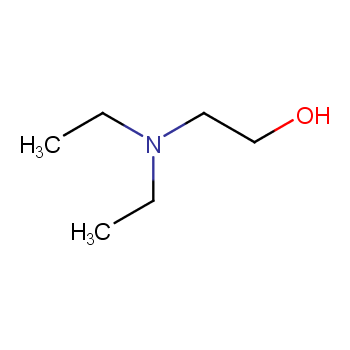
The molecular structure of DEAE (C2H5)2NC2H4OH plays a crucial role in its function. It consists of two ethyl groups (C2H5) attached to a central nitrogen atom (N). This nitrogen atom is further linked to the ethanol group (CH2CH2OH) via a methylene bridge (CH2). This structure gives the molecule both an amine group (nitrogen-containing) and a hydroxyl group (from ethanol's OH), making it versatile in various applications.

pKa refers to the pH at which half of the molecules exist in protonated form (positively charged), and the other half exist in deprotonated form (negatively charged). The similar compound to diethylaminoethanol, diethylethanolamine, has a pKa of 8.5. Diethylaminoethanol has a pKa of approximately 10.1 (25°C), with a pH of 11.5 (20°C, 100g/l). For DEAE, when the pH is below 10.1, it gains a positive charge by accepting a proton. Conversely, when the pH is above 10.1, it donates a proton and carries a negative charge. This ability to act as an acid or a base depending on the surrounding environment enables DEAE to interact with a wide range of compounds, making it a versatile tool in various applications.
Diethylaminoethanol (DEAE) offers many benefits across various applications, playing a crucial role in industrial processes to improve performance. For example, in boiler systems, DEAE can combat corrosion, a serious threat that could reduce efficiency and incur high maintenance costs. DEAE can neutralize carbonates and remove oxygen, protecting boilers, extending their lifespan, and reducing downtime. Similarly, in water treatment, DEAE aids in the removal of harmful contaminants, helping minimize the discharge of pollutants into waterways.
DEAE can also promote a greener environment. Some DEAE applications, such as its use in water treatment, can help reduce the discharge of harmful pollutants into waterways. Additionally, by improving industrial boiler efficiency, DEAE can indirectly reduce fuel consumption and associated emissions. Moreover, DEAE itself is biodegradable under certain conditions, minimizing long-term impacts on the environment.
Safety and regulatory compliance are crucial aspects of using DEAE. Regulations govern its use to ensure responsible handling and environmental protection. It's important to note that DEAE may cause skin and eye irritation, so proper personal protective equipment should always be worn when handling it.
There is a lack of data on the toxicity of DEAE to humans. Reported cases include skin and eye irritation, as well as cases of dizziness and headaches among workers in buildings using DEAE as a steam additive. In these cases, it is believed that contact through surface condensation and accumulation is the cause of irritation since the levels of DEAE in the air sampled in these buildings are much lower than the recommended levels by NIOSH (1980), i.e., the Time-Weighted Average Threshold Limit Value (TLV) is 10 ppm on the skin or approximately 50 mg/m3 (ACGIH 1980). However, the most significant industrial hazard is considered to be eye hazard from contact with the liquid, with severity comparable to that of ammonium hydroxide as an eye irritant (ACGIH 1980).
The FDA allows DEAE as a food additive for certain applications. These include its use as a vapor in direct contact with food (excluding dairy products) and as a protective coating for fresh fruits and vegetables. The conclusion drawn by the National Research Council Toxicology Committee (NRC1983) is a severe lack of data on long-term, low-level air exposure to DEAE in animals to infer human health risks. With the lack of data on DEAE concentrations in humidified buildings, there is not enough information to formulate guidance for long-term exposure or estimate health risks associated with such exposure. However, NRC was able to make some general recommendations based on the following assumptions: nitrosation reactions may occur (as below), and amines should be considered as dangerous as the nitrosated compounds they form. Recommendations are as follows:
While DEAE offers many advantages, exploring alternative solutions is always prudent. For neutralizing agents in boiler systems, alternatives such as tris (hydroxymethyl) aminomethane (Tris) or ammonia can be considered. Compatibility with other chemicals in the system, corrosion inhibition effects, and environmental impacts play crucial roles in selecting alternatives. Ultimately, the choice depends on specific applications and careful consideration of these factors to ensure optimal performance and environmental responsibility.
Diethylaminoethanol emerges as a versatile and valuable tool across industries. Its ability to neutralize corrosion, improve efficiency, and act as a surfactant gives it an edge in industrial processes, water treatment, and even household products. With further research into DEAE applications and exploration of sustainable production methods, its potential for positive impact will only grow. By embracing the multifunctionality of DEAE and fostering innovation in its use, we can further enhance performance and environmental responsibility.
[1] https://www.taylortechnologies.com/en/page/131/analyzing-amines
[2] https://eastman.com/en/products/product-detail/71103680/diethylaminoethanol#
[3] https://atamankimya.com/sayfalar.asp?LanguageID=2&cid=3&id=8&id2=9689
[4] https://pubchem.ncbi.nlm.nih.gov/compound/7497#section=InChI
|


 4YRS
4YRS

