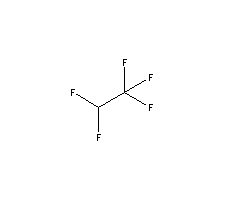
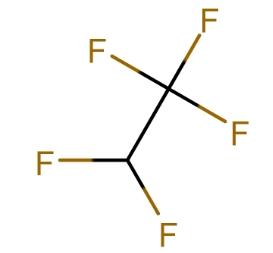
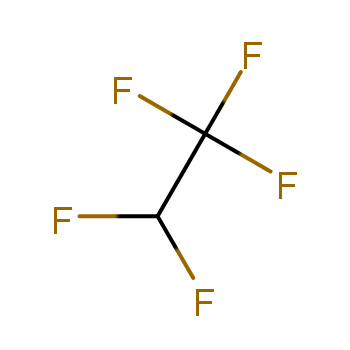
Difluoromethane and pentafluoroethane formula are CH2F2 and CHF2CF3, respectively. Due to their high Global Warming Potential (GWP), the use of hydrofluorocarbons (HFCs) is being regulated and phased out globally. Separation technology for refrigerant recovery is needed for the responsible handling of HFCs. Many of the HFCs currently in use are azeotropic or near-azeotropic refrigerant mixtures that must be separated for effective recycling and reuse. R-410A is one such refrigerant. It is a refrigerant used in air conditioning and heat pump applications, consisting of a near-azeotropic mixture of difluoromethane (CH2F2, known as R-32) and pentafluoroethane (CHF2CF3, known as R-125). R-410A is sold under trade names such as AZ-20, EcoFluorR410, Forane410A, GenetronR410A, Puron, and Suva410A. Since its molecular formula does not contain chlorine, its Ozone Depletion Potential (ODP) is zero. However, its Global Warming Potential (GWP) is high, being 1,725 times that of carbon dioxide, similar to R-22.
On December 27, 2020, the U.S. Congress passed the American Innovation and Manufacturing (AIM) Act, which requires the Environmental Protection Agency (EPA) to gradually reduce the production and use of hydrofluorocarbons (HFCs). Due to the high GWP of HFCs, the AIM Act mandates an 85% reduction in HFC production and consumption from 2022 to 2036. Because R-410A contains HFC-125, it will also be subject to these regulations. In most applications, R-410A will be replaced by refrigerants with a lower Global Warming Potential, similar to how R-410A replaced the earlier ozone-depleting refrigerant R-22.
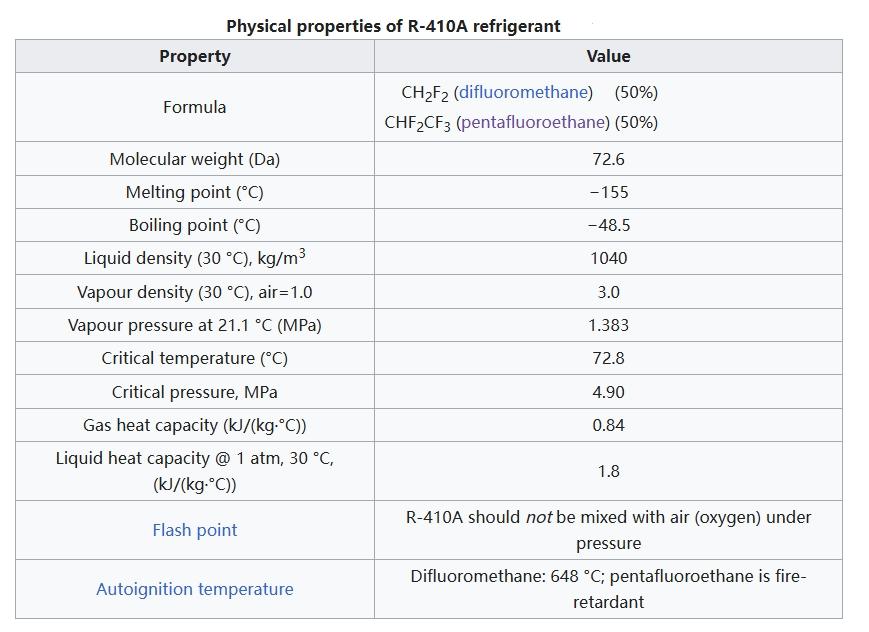
In the class of hydrochlorofluorocarbon (HCFC) refrigerants, R-22 has been widely used in air conditioning, low-temperature, and food freezing due to its excellent thermodynamic, chemical, and physical properties. However, R-22 is a refrigerant that has some destructive effect on the ozone layer, with an Ozone Depletion Potential (ODP) of 0.055 (taking CFC-11 as the benchmark value of 1.0). In recent years, the environmental impact of R-22 has received increasing attention. In addition, R-22 also contributes significantly to global warming, with a GWP value of 1,700 (using CO2 as the baseline value of 1.0). These issues indicate that replacing R-22 in the refrigeration and air conditioning field is imperative.
Lianxin Company is one of the earliest companies to research and develop alternatives to R-22 refrigerants. They developed R-410, a near-azeotropic mixture composed of HFC-125 (50wt%) and HFC-32 (50wt%), offering advantages such as good stability, non-flammability, and excellent oil solubility. R-410 has all the benefits of pure refrigerants, providing ease of operation for refrigerant charging and equipment replacement. Compared to R-22, R-410 has significantly higher evaporation pressure, condensation pressure, and unit volumetric cooling capacity. Therefore, it cannot directly replace the original R-22 in air conditioning systems. When using R-410, the compressor, piping, and entire system must be redesigned to accommodate its performance characteristics.
The near-azeotropic mixture R-410A, composed of HFC-125 (50wt%) and HFC-32 (50wt%), is widely used as a medium-low temperature refrigerant in various applications, including household air conditioners, small to medium commercial air conditioners (packaged units, residential central air conditioning, multi-split units), portable air conditioners, dehumidifiers, refrigerated dryers, marine refrigeration equipment, and industrial refrigeration.
No reaction occurs under normal processing, and the product remains stable under standard ambient temperature storage. However, as it contains pressurized gas, it may explode if heated.
When using difluoromethane and pentafluoroethane, the following safety measures should be taken: Use explosion-proof equipment, tools, and ventilation facilities, and ensure good ventilation. Wear personal protective equipment as needed. Avoid inhaling the gas and prevent contact with skin, eyes, and clothing. Take all necessary precautions to avoid mixing with incompatible materials. Ensure proper process controls to prevent excessive waste discharge (e.g., temperature, concentration, pH, time). Avoid contact with soil, surface water, or groundwater. Keep away from heat sources, hot surfaces, sparks, open flames, and other ignition sources. No smoking. Ensure equipment is well-grounded and use only non-sparking tools, keeping away from heat sources.
R-410A refrigerant cylinders are pressurized containers and should be stored away from fire sources and heat, avoiding direct sunlight. They are typically stored in cool, dry, and well-ventilated warehouses. During handling, care should be taken to prevent damage to the cylinder and valve accessories.
|
 |
 |


 1YR
1YR