
Perindopril
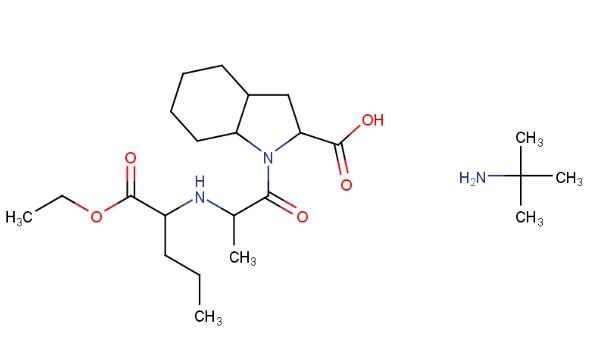
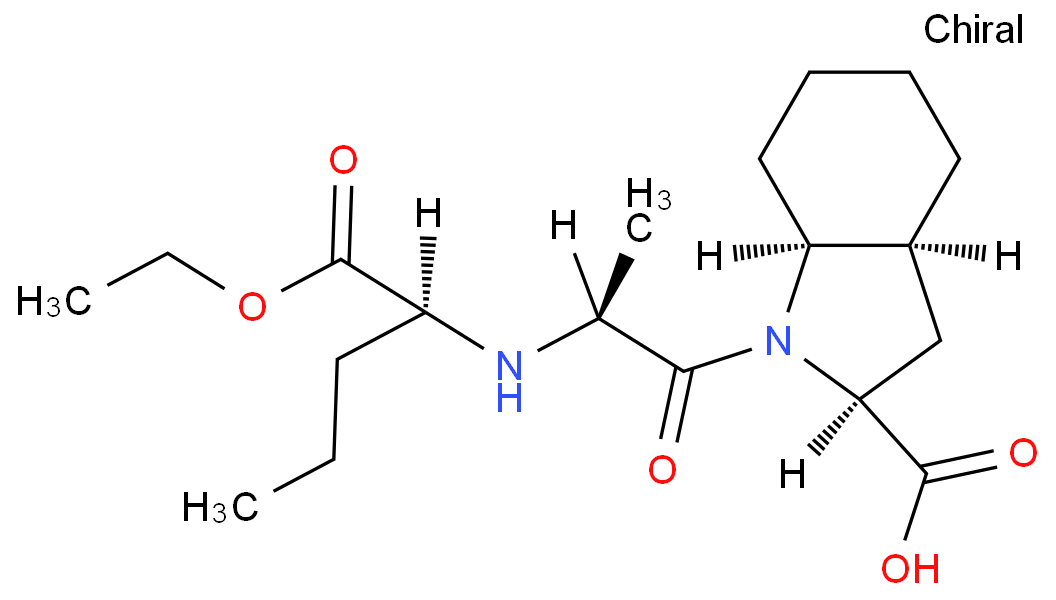
Perindopril is a medication used for treating hypertension, heart failure, or stable coronary artery disease. As a long-acting ACE inhibitor, its role is to relax blood vessels and reduce blood volume. Being a prodrug, Perindopril is converted to its active metabolite, Perindoprilat, in the liver. It was patented in 1980 and approved for medical use in 1988. Perindopril is available in the form of Perindopril arginine (containing arginine, brand names include Coversyl, Coversum) or Perindopril erbumine (containing erbumine [tert-butylamine], brand name Aceon). Both forms are therapeutically equivalent and interchangeable, but the dosages required for achieving the same effect differ between the two forms. It is also frequently used in combination with another drug, sometimes in the same tablet.

Enalapril, marketed under brand names like Vasotec, is an ACE inhibitor used to treat hypertension, diabetic nephropathy, and heart failure. It is often combined with diuretics (such as furosemide) when treating heart failure. The medication can be administered orally or intravenously. It typically takes effect within an hour of oral administration, with effects lasting up to a day. It belongs to the class of ACE inhibitors.

Compared to many other ACE inhibitors, especially Enalapril, Perindopril has a longer duration of action, stronger tissue-ACE binding, and higher selectivity for bradykinin sites. Perindopril inhibits endothelial cell apoptosis, improves transforming growth factor and collagen III, and significantly enhances the expression and activity of endothelial nitric oxide synthase in the aorta. Moreover, Perindopril shows better anti-inflammatory, anti-atherosclerotic, antioxidant, and fibrinolytic effects compared to Enalapril. The side effects of Perindopril and Enalapril are similar to those of other ACE inhibitors.
ACE inhibitors are crucial in controlling hypertension, correcting certain pathophysiological disorders, and improving prognosis. A placebo-controlled, double-blind, crossover study using 24-hour ambulatory blood pressure monitoring compared the efficacy of 4-8 mg Perindopril and 10-20 mg Enalapril administered once daily to 32 patients. For diastolic blood pressure (DBP), the placebo-corrected peak reduction (P) for Perindopril was -6.4 +/- 1.3 mmHg, and the trough reduction (T) was -5.2 +/- 1.7 mmHg. Enalapril's DBP reduction was -8.5 +/- 1.3 mmHg (P) and -5.7 +/- 1.7 mmHg (T). For systolic blood pressure (SBP), Perindopril reduced -7.5 +/- 1.6 mmHg (P) and -7.3 +/- 2.2 mmHg (T), while Enalapril reduced -10.8 +/- 1.6 mmHg (P) and -8.3 +/- 2.3 mmHg (T). The trough-to-peak ratio (SBP/DBP) for Perindopril was 0.97/0.81, while for Enalapril it was 0.77/0.67. There were no differences in 24-hour average blood pressure, area under the curve, or random blood pressure measurements post-treatment. Both Perindopril and Enalapril were well-tolerated, with similar safety profiles. Thus, Perindopril offers predictable and sustained blood pressure effects with 24-hour coverage, without excessive peak or poor trough effects.
All ACE inhibitors are administered orally, but Enalapril can also be given intravenously. The initial intravenous dose of Enalapril is 0.625 to 1.25 mg every 6 hours, which can be gradually increased to 5 mg every 6 hours. In elderly patients, dosing should start at the lowest adult dose. Perindopril (Coversyl in the UK, Aceon in the US; for hypertension, 4 to 8 mg once daily) has a long-lasting effect. Perindopril requires only once-daily dosing, while some other ACE inhibitors need to be taken three times a day. Relevant studies include:

In a double-blind crossover study involving 10 patients on Enalapril (10 mg, n = 4; 20 mg, n = 6) and 10 patients on Perindopril (4 mg, n = 6; 8 mg, n = 4), blood pressure was measured at 0, 2, 3, 4, and 24 hours. They alternated between placebo and active medication every week. After taking 4 mg Perindopril and 10 mg Enalapril, blood pressure control was similar 2 to 4 hours post-administration (Perindopril = 150 ± 2/80 ± 1; Enalapril = 150 ± 2/81 ± 1). After 24 hours, blood pressure was lower in those taking Perindopril (Perindopril = 154 ± 3/85 ± 2; Enalapril = 159 ± 3/89 ± 2). Enalapril showed greater blood pressure reduction 2 to 4 hours post-administration compared to placebo, whereas Perindopril’s effects were similar to placebo. After 24 hours, adjusted for placebo and circadian rhythm changes, Perindopril's blood pressure was similar to peak effects, while Enalapril’s was higher. This study suggests that Perindopril has a longer duration of action than Enalapril, making it more suitable for once-daily use.
Jirí Vítovec and colleagues compared the initial dose response of low-dose Enalapril and Perindopril in patients with stable symptomatic chronic heart failure. Patients with ischemic heart disease or dilated cardiomyopathy, NYHA II-IV, ejection fraction < 40%, age > 18, and no prior use of ACE inhibitors or ATI receptor blockers (N = 298) were randomized to a single dose of 2.5 mg Enalapril or 2.0 mg Perindopril. The study found that Perindopril was well-tolerated at low doses in chronic heart failure patients, with less hypotension compared to low-dose Enalapril.
Enalapril and Perindopril each have their own characteristics and advantages in treating hypertension and cardiovascular diseases. Although both are ACE inhibitors, individual patient health conditions and responses to medication may vary. It is essential to consult with a physician when choosing between these medications. Professional medical advice will ensure the safe and effective management of the condition and help in selecting the best treatment plan.
[1]Vítovec J, ?pinar J, Czech and Slovak Investigator Group. First‐dose hypotension after angiotensin‐converting enzyme (ACE) inhibitors in chronic heart failure: a comparison of enalapril and perindopril[J]. European Journal of Heart Failure, 2000, 2(3): 299-304.
[2]https://zh.wikipedia.org/wiki/%E4%BE%9D%E9%82%A3%E6%99%AE%E5%88%A9
[3]https://en.wikipedia.org/wiki/Perindopril
[4]https://www.ncbi.nlm.nih.gov/pmc/articles/PMC4171793/
[5]https://www.nhs.uk/medicines/perindopril/common-questions-about-perindopril/
[6]https://onlinelibrary.wiley.com/doi/full/10.1016/S1388-9842%2800%2900095-7
[7]https://www.drugs.com/compare/enalapril-vs-perindopril
[8]https://academic.oup.com/ajh/article/7/4_Pt_1/371/134371
[9]https://pubmed.ncbi.nlm.nih.gov/10563072/
[10]https://www.ncbi.nlm.nih.gov/books/NBK430896/
|
 |
 |


 3YRS
3YRS


