Ethylene brassylate is a widely used synthetic fragrance in perfumes, shampoos, and cosmetics, with ethylene brassylate safety concerns attracting significant attention. As a synthetic alternative to natural musk, ethylene brassylate holds a significant position in the fragrance industry, but its long-term effects on human health and the environment still require further evaluation. This article explores the properties of ethylene brassylate, toxicological research findings, and ethylene brassylate safety assessments in various applications, providing scientific evidence for consumers and manufacturers and guiding future research and regulations.
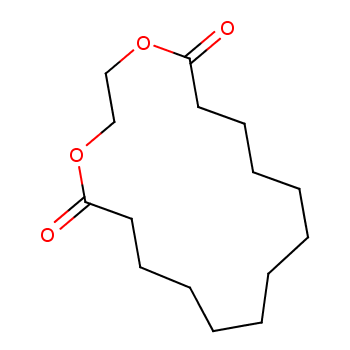
Ethylene brassylate, also known as musk T, is an organic compound with the chemical formula C15H26O4. It is characterized by a long aliphatic chain and two ester groups at positions 5 and 17. Ethylene brassylate is a key ingredient in the perfume industry, renowned for its pleasant floral and fruity scent. It is used in perfumes, cosmetics, and household products. Research indicates potential biological applications of ethylene brassylate, including its role in plant-insect interactions and antibacterial properties.
Is ethylene brassylate safe? The ethylene brassylate safety is not fully established. While some organizations consider it safe at specific concentrations, concerns about potential allergic reactions have been raised by the European Commission.
Ethylene brassylate has undergone comprehensive evaluation and is a commonly used fragrance ingredient. It has been identified by the European Consumer Safety Scientific Committee (SCCS) as a potential skin sensitizer. This means that ethylene brassylate has the potential to cause skin reactions such as redness, bumps, or itching. These reactions may be challenging to identify and are likely caused by a combination of natural and synthetic ingredients.
The Environmental Working Group (EWG) has not established specific regulations for ethylene brassylate itself. The EWG rates cosmetic ingredients for potential harm, and ethylene brassylate scores low for common concerns such as cancer, allergies and immunotoxicity, developmental and reproductive toxicity, and usage restrictions.
The substance is recognized as safe (GRAS) by the United States Food and Drug Administration only for household cleaning agents.
It is harmful to aquatic environments (acute) - category 2; harmful to aquatic environments (long-term) - category 2.
The Research Institute for Fragrance Materials (RIFM) has evaluated ethylene brassylate and concluded that it is not a skin sensitizer and does not cause skin reactions such as redness, bumps, or itching. In this assessment, RIFM identified the concentration of ethylene brassylate that is not expected to induce sensitization, known as the No Expected Sensitization Induction Level (NESIL). Safety information on ethylene brassylate is somewhat contradictory. Some sources, like Paula's Choice, acknowledge a lack of extensive research but consider it generally non-toxic. However, it still has the potential to cause irritation.
Fragrance materials are widely used in various consumer products, including personal care and household items. Aroma compounds (also known as fragrance blends or essential oils) consist of specific combinations of individual materials or mixtures. Consumer exposure to fragrance materials ranges from skin contact to inhalation. To ensure the safe use of fragrance materials, the Research Institute for Fragrance Materials (RIFM) was established. The figure below outlines a decision tree summarizing the general steps required for an overall assessment to determine acceptable exposure to fragrance materials.
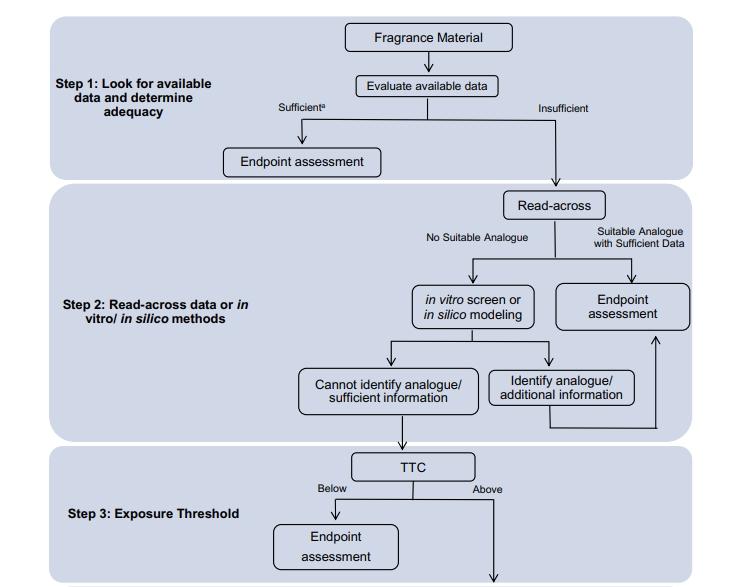
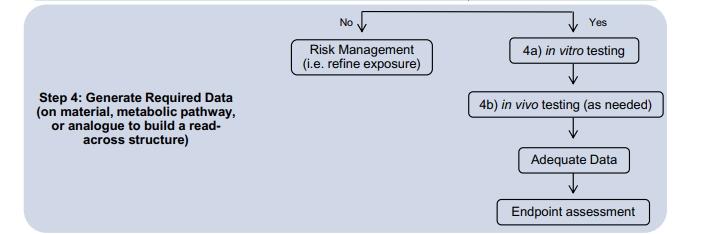
The Research Institute for Fragrance Materials (RIFM) has assessed the genetic toxicity, repeated dose toxicity, developmental and reproductive toxicity, local respiratory toxicity, phototoxicity/photomutagenicity, skin sensitization, and environmental ethylene brassylate safety. The data indicate that this material does not exhibit genetic toxicity and has no potential for skin sensitization. Local respiratory toxicity endpoints were completed using a Toxicological Threshold of Concern (TTC) for Cramer Class I materials (1.4 mg/day). Repetitive dose toxicity endpoints were completed using decyl ethanoate (CAS # 54982-83-1) as an appropriate surrogate readout, with an MOE > 100. Developmental and reproductive toxicity endpoints were completed using oxahexahydrocyclopentapyrrole (12E)- (CAS # 111879-80-2) as an appropriate analogue readout, with an MOE > 100. Phototoxicity/photomutagenicity endpoints were completed based on appropriate UV spectra and data for the target material. Specifically:
(1) Usage (global): 1000 tons per year (IFRA, 2011)
(2) 95th percentile concentration of hydroxyl compounds: 3.5% (RIFM, 2013)
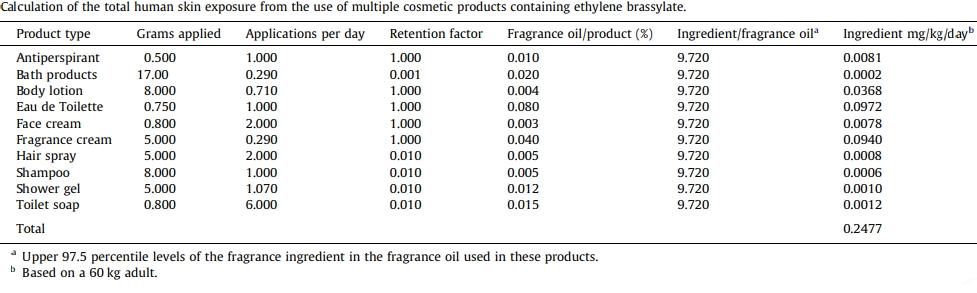
(3) Inhalation exposure: 0.0030 mg/kg/day or 0.21 mg/day (RIFM, 2013)
(4) Total systemic exposure: 0.079 mg/kg/d (RIFM, 2013)
(1) Dermal: Assumed 100%
(2) Oral: Assumed 100%
(3) Inhalation: Assumed 100%
Ethylene brassylate's mutagenic potential was evaluated through Ames tests according to GLP regulations and OECD TG 471. Metabolic activation and non-activation tests were conducted using Salmonella typhimurium strains TA1535, TA1537, TA98, TA100, and Escherichia coli strain WP2uvra with ethylene brassylate at concentrations up to 5000 mg/plate (ECHA REACH dossier). Under these experimental conditions, it was concluded that ethylene brassylate has no mutagenic effect on bacteria.
Based on existing data, ethylene brassylate does not exhibit potential genetic toxicity.
At current levels of use, the exposure range of ethylene brassylate is sufficient to reach developmental toxicity endpoints.
There is no data on the reproductive toxicity of ethylene brassylate. In the OECD 415 oral gavage study conducted in rats, a NOAEL of 1000 mg/kg/day was established, which was the highest dose tested (RIFM, 2003b). Therefore, the MOE for reproductive toxicity is equal to the oxahexahydrocyclopentapyrrole (12E)- NOEL (mg/kg/day) divided by the total systemic exposure, 1000/0.079 or 12658.
Based on existing data, ethylene brassylate does not cause skin sensitization.
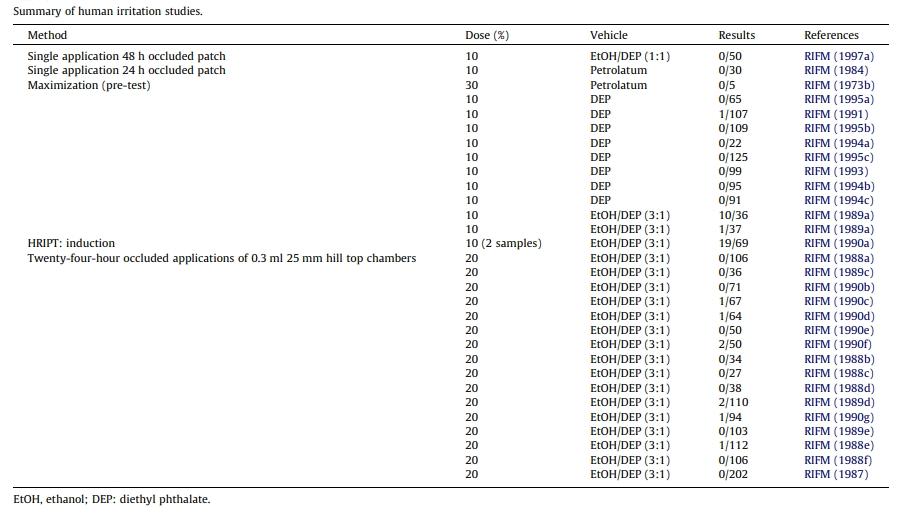
Based on existing data, it is not believed that ethylene brassylate causes skin sensitization. Prediction by the silica method suggests that ethylene brassylate has the potential for protein reactivity. Experimental evidence from chemical research indicates that the material lacks significant reactivity with peptides based on cysteine (OECD Toolbox V3.1; Natsch et al., 2007; Roberts and Natsch, 2009). Brazilian ethylene brassylate was negative in the LLNA and guinea pig sensitization tests (RIFM, 1997 b; RIFM, 1997 c; RIFM, 2004). In the HRIPT, no sensitization reactions to ethylene brassylate were observed in human repeat insult patch tests (data summarized by Belsito et al., 2011).
It is important to note that everyone's skin is different, so if you suspect you may have a skin reaction to a product containing this ingredient, be sure to see a dermatologist. The fragrance industry supports the disclosure of known sensitizers in products so that individuals with skin reactions to ingredients can choose products that suit them.
Ethylene brassylate is generally considered safe for most people. However, there is some conflicting information about its potential to cause skin irritation. Here are some best practices for incorporating ethylene brassylate into products:
Limit the concentration of ethylene brassylate to recommended levels. Typically, this ratio is around 0.5% to 3.0% in the final product.
For those looking to avoid any potential risks, using alternatives like Zenolide may be a good option.
Before using new products, especially if you have sensitive skin, do a patch test on a small area on the inner arm. Apply a small amount and wait for 24 hours. If you experience any redness, itching, or burning, discontinue use and wash with soap and water.
If you experience any irritation after using products containing ethylene brassylate, discontinue use and consult a doctor if necessary.
Ethylene brassylate is a synthetic fragrance used in perfumery. It contributes to the base notes of a scent and has a complex aroma. The most common descriptions of ethylene brassylate include sweet, floral, powdery, and musky. Some people can detect subtle differences such as peach, apricot, or even honey. It blends well with other fragrance ingredients, enhancing the complexity and longevity of perfumes.
Ethylene brassylate is not a natural ingredient. It is a laboratory-manufactured compound used by perfumers to achieve desired olfactory characteristics. In the past, natural musk was sourced from animals like musk deer. However, synthetic alternatives like ethylene brassylate have become more popular due to ethical and conservation considerations. Regulatory agencies worldwide consider the use of ethylene brassylate in cosmetics to be safe.
Ethylene brassylate, as a synthetic fragrance, has been subject to varying degrees of evaluation for safety in multiple studies. Existing toxicological data suggest that ethylene brassylate has minimal effects on human health and the environment at typical usage levels. However, considering its widespread application and potential risks from long-term exposure, continued monitoring and further research are necessary. To ensure the safe use of ethylene brassylate, adherence to relevant regulations and safety standards is crucial, along with ongoing updates to scientific data to address emerging safety concerns.
[1] Criteria-for-RIFM-Safety-Evaluation-Process-for-Fragrance-Ingredients
[2] Api A M, Belsito D, Bhatia S, et al. RIFM fragrance ingredient safety assessment, ethylene brassylate, CAS Registry Number 105-95-3[J]. Food and chemical toxicology, 2016, 97: S192-S200.
[3] https://www.ewg.org/cleaners/substances/2106-ETHYLENEBRASSYLATE/
[4] https://rifm.org/safety-assessment-program/
[5] https://fragranceconservatory.com/ingredient/ethylene-brassylate
[6] https://pubchem.ncbi.nlm.nih.gov/compound/61014
 |
 |
 |


 2YRS
2YRS