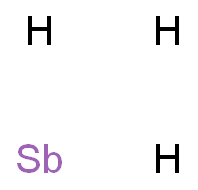
Stibine (SbH?), also known as antimony trihydride, is an inorganic compound composed of one antimony (Sb) atom and three hydrogen (H) atoms. This compound is similar to ammonia (NH?), but with antimony replacing nitrogen. Stibine is a colorless, flammable gas that is highly toxic. It has a molecular formula of SbH?, and its structure consists of an antimony atom bonded to three hydrogen atoms. The bonding in stibine is covalent, and the compound exhibits a trigonal pyramidal molecular geometry, similar to that of ammonia. Despite the polar bonds between antimony and hydrogen, stibine is considered nonpolar as a whole. So, why is stibine nonpolar? Let's explore the concept of polarity and the factors that influence it.
Polarity in chemistry refers to the distribution of electrical charges across atoms or molecules. A molecule is considered polar if it has a net dipole moment, which means there is an uneven distribution of charge within the molecule. This happens when atoms with different electronegativities form bonds, resulting in partial positive and negative charges. Polarity is influenced by molecular geometry, electronegativity differences, and the symmetry of the molecule.
Stibine (SbH?) is a covalent compound with a trigonal pyramidal molecular structure. Although the bonds between antimony and hydrogen are polar due to the difference in electronegativity, the molecule itself is nonpolar overall. This is due to the symmetry of the molecule and the fact that the dipoles from the Sb-H bonds cancel out, resulting in no net dipole moment.
Molecular Geometry: Stibine has a trigonal pyramidal molecular geometry, where the central antimony atom is bonded to three hydrogen atoms. The lone pair on the antimony atom creates a bent structure, similar to ammonia (NH?). This geometry, while asymmetrical in terms of bonding, does not create a net dipole moment because the individual dipoles from the Sb-H bonds cancel each other out.

Dipole Moment: The dipole moment of a molecule depends on the vector sum of the bond dipoles. Although the Sb-H bonds are polar (because antimony has a higher electronegativity than hydrogen), the symmetry of the trigonal pyramidal shape means that the bond dipoles cancel each other out. As a result, stibine has no overall dipole moment, making it nonpolar.
Electronegativity: Antimony has an electronegativity of 2.05, and hydrogen has an electronegativity of 2.20. The small difference in electronegativity between antimony and hydrogen means that the Sb-H bonds are only weakly polar. However, because of the molecular geometry, these polarities do not result in an overall dipole moment.

| Stibine SbH? | |
| Molecular formula | SbH? |
| Molecular shape | Trigonal pyramidal |
| Relative molecular mass | 121.75 g/mol |
| Solubility | Soluble in organic solvents, slightly soluble in water |
| Boiling point | -17.3 °C |
| Melting point | -91.5 °C |
| Compound | Polarity | Applications |
| Phosphine (PH?) | Nonpolar (trigonal pyramidal structure) | Used in the semiconductor industry and as a fumigant. |
| Arsine (AsH?) | Nonpolar (similar structure to stibine) | Used in semiconductor manufacturing and in chemical synthesis. |
After exploring the polarity chemistry of SbH?, have you gained a deeper understanding of whether it is "polar or nonpolar"? While SbH? as a molecule is polar, this does not necessarily mean that all of its bonds are polar bonds. If you're interested in similar compounds or related supply chain resources, Guidechem offers a comprehensive list of global Stibine suppliers, where you can find the right procurement plan to meet your research and production needs.
 |
|