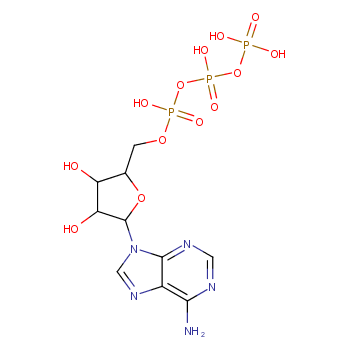
Adenosine Triphosphate (ATP) is a vital biomolecule composed of an adenine base attached to a ribose sugar and three phosphate groups. It is often referred to as the "energy currency" of cells, playing a crucial role in energy transfer within biological systems. ATP is involved in numerous cellular processes, including muscle contraction, biosynthesis, and active transport. Its structure adheres to the octet rule, ensuring stability through the arrangement of electrons.
Adenosine Triphosphate (ATP) is a complex organic compound with the chemical formula C10H16N5O13P3. It is a high-energy molecule that stores and transfers energy in living organisms. ATP consists of an adenine base, a ribose sugar, and three phosphate groups. It is essential for various biological processes such as muscle contraction, biosynthesis, and active transport. ATP is stable and highly reactive, making it a key player in cellular metabolism.

Let's dive into drawing the Lewis structure of ATP:
Step 1: Identify the Central Atoms: The central atoms in ATP are carbon (C), nitrogen (N), oxygen (O), and phosphorus (P). Carbon is the primary backbone, while nitrogen, oxygen, and phosphorus form functional groups.
Step 2: Calculate Total Valence Electrons: Carbon contributes 4 valence electrons, nitrogen contributes 5, oxygen contributes 6, and phosphorus contributes 5. Additionally, there are multiple oxygen atoms and phosphorus atoms, contributing more valence electrons. The exact total depends on the specific structure.Adenosine triphosphate has 174 valence electrons shared by 47 atoms and 49 bonds.
Step 3: Arrange Electrons Around Atoms: Draw the adenine base (adenine connected to ribose) and the three phosphate groups. Use single bonds, double bonds, and triple bonds as needed to connect these components and distribute remaining electrons as lone pairs around each atom.
Step 4: Fulfill the Octet Rule: Ensure each atom has eight electrons (two lone pairs and one bonding pair), and the adenine base and phosphate groups achieve stability through proper electron distribution.
Step 5: Check for Formal Charges: Ensure formal charges are balanced across the molecule, indicating a stable structure.
The structure of Adenosine Triphosphate (ATP) is complex and involves multiple functional groups. The molecular geometry of ATP includes a central adenine base, a ribose sugar, and three phosphate groups. The overall geometry is determined by the spatial arrangement of these components, which ensures minimal electron-electron repulsion and maximum stability.

This theory addresses electron repulsion and the need for compounds to adopt stable forms. In ATP, the molecular orbital theory helps explain the distribution of electrons across the adenine base, ribose sugar, and phosphate groups. The theory suggests that electrons are distributed across multiple orbitals, leading to a stable molecular structure with minimal repulsion.
The Lewis structure suggests that ATP adopts a complex molecular geometry due to its multiple functional groups. The adenine base, ribose sugar, and three phosphate groups are arranged to minimize electron-electron repulsion, resulting in a stable configuration.
The orbitals involved and the bonds produced during the interaction of carbon, nitrogen, oxygen, and phosphorus molecules will be examined to determine the hybridization of Adenosine Triphosphate. The orbitals involved include 2s, 2p, 3s, 3p, and 3d. The carbon atom, which is the central atom in its ground state, will have the 2s22p2 configuration in its formation.
The electron pairs in the 2s and 2p orbitals become unpaired in the excited state, and one of each pair is promoted to the unoccupied 3s and 3p orbitals. All six half-filled orbitals (one 2s, three 2p, and two 3d) hybridize now, resulting in the production of multiple hybrid orbitals.
The bond angles and bond lengths in ATP vary depending on the specific functional group. For example, the bond angle between the phosphate groups is approximately 90 to 120 degrees. The bond length in ATP varies, with typical values ranging from 130 to 150 pm for the P-O bonds and 150 to 160 pm for the C-O bonds.
| Adenosine Triphosphate (ATP) | |
| Molecular formula | C10H16N5O13P3 |
| Molecular shape | Complex |
| Polarity | Polar |
| Hybridization | Multiple hybridizations (sp3, sp2, etc.) |
| Bond Angle | Varies (approx. 90-120 degrees) |
| Bond length | Varies (approx. 130-160 pm) |
To determine if a Lewis structure is polar, examine the molecular geometry and bond polarity. In the case of Adenosine Triphosphate (ATP), the Lewis structure shows a complex arrangement of atoms. The presence of multiple functional groups, such as phosphate groups, indicates that ATP is a polar molecule due to the asymmetry and the presence of charged regions.
To calculate the total bond energy of ATP, look up the bond energies for individual bonds, such as the P-O and C-O bonds. Multiply the bond energy of each type of bond by the number of bonds. This gives a total bond energy for ATP, which can be estimated based on the specific bond types and their frequencies.
Bond order is the number of chemical bonds between a pair of atoms. In the Lewis structure of ATP, each bond is typically a single bond, so the bond order for each bond is 1. If a molecule has resonance structures, bond order is averaged over the different structures, but ATP does not have significant resonance, so the bond order remains 1.
Electron groups in a Lewis structure include both bonding pairs (shared electrons) and lone pairs (non-bonded electrons) around an atom. In ATP, each atom has multiple electron groups around it, corresponding to the various functional groups and bonds.
In a Lewis dot structure, the dots represent valence electrons. Each dot corresponds to one valence electron of an atom. In ATP, various atoms are represented by dots, showing how electrons are shared or paired between atoms.
|
 |



 1YR
1YR