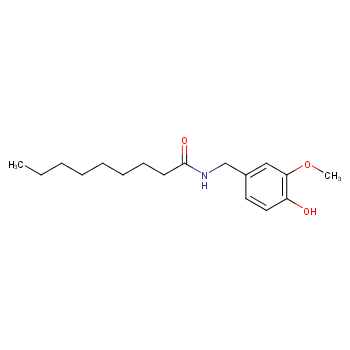
Nonivamide (chemical name N-(4-hydroxy-3-methoxybenzyl)-nonanamide), also known as synthetic capsaicin, is an analogue of natural capsaicin with a structure and function similar to that of capsaicin. Its pungency and irritancy are approximately 3/5 of capsaicin, while its synthesis cost is less than 1/10 of that of capsaicin, making it a cost-effective alternative in certain applications. In the pesticide industry, capsaicin analogues are considered ideal non-toxic pesticides. The use of capsaicin as a biological pesticide has been reported in the United States and Japan since the 1960s. In 1991, the U.S. Environmental Protection Agency (EPA) classified capsaicin analogues as biochemical pesticides and further removed the restrictions on residue levels on fruits, vegetables, and grains, as well as requirements for resistance and residue testing. In China, various products have been developed, such as capsaicin-tea saponin insecticides, capsaicin-nicotine microemulsions, capsaicin-fish toxin insecticides, and abamectin-capsaicin microemulsions.
In existing technologies, nonivamide is generally synthesized by the condensation of vanillylamine and carboxylic acid chloride. This method requires the reaction of nonanoic acid with thionyl chloride to produce nonanoyl chloride, which generates harmful gases such as hydrogen chloride and sulfur dioxide. Additionally, due to the poor solubility of vanillylamine, the two reactive groups -NH2 and -OH on the benzene ring of vanillylamine can condense with carboxylic acid chloride under certain conditions, leading to a low yield of the target product nonivamide, with many by-products. The phenolic ester by-products are difficult to separate, making post-processing challenging and requiring a large amount of organic solvents, thus complicating the process and introducing solvent recovery issues.
Kong Xue and others synthesized nonivamide from vanillin and nonanoic acid via amination reduction and N-acylation reactions. The synthesis route is as follows:

Yuan Yubin and others started with 4-hydroxy-3-methoxybenzaldehyde, which underwent oximation, aluminum-nickel alloy/sodium hydroxide reduction, and acidification to obtain vanillylamine hydrochloride. They then reacted nonanoyl chloride with vanillylamine hydrochloride under alkaline conditions at the interface of aqueous/chloroform solvent phases to synthesize nonivamide. The overall synthesis steps are illustrated as follows:

Yuan Yubin and others used vanillylamine hydrochloride and nonanoyl chloride under alkaline conditions at the aqueous/organic solvent biphasic interface to conduct the condensation reaction. The crude product was purified by acid-base extraction to yield capsaicin nonivamide. Specific experiments are as follows:

Synthesis of Nonanoyl Chloride: In a 100mL single-neck flask equipped with a magnetic stirrer and reflux condenser, 6.4g (40 mmol) of nonanoic acid was added. Thionyl chloride (4.8g, 40 mmol) was slowly dripped into the flask at room temperature over approximately 30 minutes. After stirring for 15 minutes, the mixture was heated and refluxed for 1.5 hours. The solvent was removed under reduced pressure to obtain 6.9g of colorless liquid nonanoyl chloride with a yield of 98.5%.
Synthesis and Purification of Nonivamide: In a 100mL flask with mechanical stirring and reflux condenser, 3.0g (16 mmol) of vanillylamine hydrochloride and 1.3g (33 mmol) of sodium hydroxide were added. Then 30mL of deionized water and 22mL of chloroform were added. At room temperature, a solution of 2.8g (16 mmol) of nonanoyl chloride in 8mL of chloroform was added dropwise over 20 minutes, followed by continued reaction for 2 hours. The mixture was separated, and the aqueous layer was extracted with 8mL x 2 of chloroform. The combined organic layers were evaporated under reduced pressure at 40°C. The resulting brown oil was first dissolved in 30mL of 2.0% sodium hydroxide solution and then adjusted to pH 9.0 with 4.0% sulfuric acid solution. After cooling overnight in a refrigerator, the product was filtered, vacuum-dried, yielding 4.1g of white solid nonivamide with a yield of 87.2%, mp 56°C-58°C.
Zhu Wenlei and others synthesized nonivamide using 3-methoxy-4-hydroxybenzylamine (vanillylamine) and nonanoic acid as starting materials. The reaction was carried out in an organic solvent at a specific temperature with molecular sieves as a desiccant and under the catalysis of aryl boric acid. After stirring for some time, the crude product was processed to obtain nonivamide. The reaction is as follows:

In a 500mL three-neck flask, 2-((N, N-diisopropyl)methyl)phenylboric acid (0.0327 mol, 10 mol%) was added to 200mL of dichloromethane. Activated molecular sieves were stirred, and vanillylamine (50g, 0.327 mol) was added at room temperature. The mixture was heated to 40°C and refluxed, while nonanoic acid (43g, 0.272 mol) was added dropwise. After maintaining reflux and stirring for 0.5 hours, the reaction was completed. The mixture was cooled to room temperature, and water (100mL) was added. After stirring for 5 minutes and allowing it to settle, the oil layer was separated. The dichloromethane was recovered under reduced pressure at 30°C, resulting in a pale yellow transparent liquid. After cooling to room temperature, vigorous stirring for 30 minutes resulted in 79.6g of white solid powder with a yield of 95.8% and HPLC purity of 99.3%.
 |
|
 |


 1YR
1YR

