
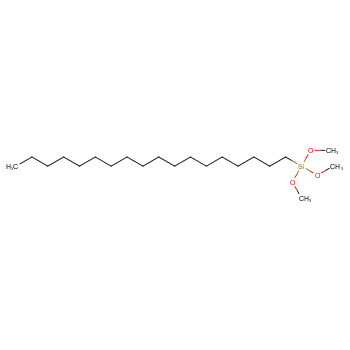
Octadecyltrimethoxysilane, CAS: 3069-42-9, molecular formula: C21H46O3Si, appearance: pale yellow liquid, density: 0.883 g/mL at 25°C (lit.), boiling point: 170°C (0.1 mmHg), melting point: 16-17°C (lit.), is an organosilicon compound commonly known as OTMS. This colorless liquid is used for preparing hydrophobic coatings and self-assembled monolayers. The formation of OTMS monolayers can be used to transform hydrophilic surfaces into hydrophobic ones, applicable in fields like nanotechnology and analytical chemistry. As a common silane coupling agent, Octadecyltrimethoxysilane modifies various substances. Synthesized by the addition of trimethoxysilane and octadecene with differing boiling points, the crude product requires distillation to obtain high-purity Octadecyltrimethoxysilane.
Silane Coating on Copper: F. Zucchi and others studied the formation of protective layers by immersing copper samples in aqueous-alcoholic solutions of long-chain fatty silane agents (Octadecyltrimethoxysilane, OctadecS). Simple soaking resulted in poor protection. Aging, particularly curing, improved the inhibition performance, forming thicker and more durable silane layers. The interaction between the long fatty chains of OctadecS molecules and their silanol groups' condensation is thought to contribute to the formation of thick, effective silane coatings.
Self-Assembled Monolayers (SAMs): Shingo Norimoto and colleagues analyzed the surface coverage of self-assembled monolayers (SAMs) of octadecyl silane on silicon using infrared external-reflection spectroscopy. A commercially available Octadecyltrimethoxysilane (ODS) solution rapidly reacted with UV/ozone-treated Si (100) oxide surfaces under ambient conditions, producing highly reproducible SAMs. This technique yields very flat and pore-free surfaces across the entire SAM area, with the alkyl chains highly ordered in an all-trans zigzag conformation.
Nanoscale Wire Synthesis: Deliang Yi and others reported the synthesis of highly flexible and mechanically strong hybrid silica nanowires (NWs), which can be used as novel building blocks for superhydrophobic functional materials. Mechanistic studies show that introducing trimethoxy (octadecyl) silane at the water-oil interface plays a key role in stabilizing water droplets below 100 nm and growing an octadecyl layer on the NW surface.
Silane Coatings for Magnesium Alloy Corrosion Protection: F. Zucchi, Ad, and colleagues evaluated the protective properties of long-alkyl-chain organosilane coatings on AZ31 magnesium alloy using electrochemical methods. The coatings formed in octyl or Octadecyltrimethoxysilane aqueous-alcoholic baths were hydrolyzed at different pH values. At all pH levels, coatings from lower homologs were porous and offered little protection. The higher homolog Octadecyltrimethoxysilane coatings provided better corrosion resistance, with optimal hydrolysis occurring at pH 5, forming thick, nearly defect-free coatings. No significant corrosion was observed after 1000 hours of immersion in 0.05 M Na2SO4 solution.
Nanofiller Preparation: Bao Jihua and others prepared self-repairing anticorrosion coatings with superhydrophobic properties by modifying halloysite nanotubes (HNTs) loaded with benzotriazole (BTA) as nanofillers and coating their outer surface with Octadecyltrimethoxysilane (OTMS).
Hydrophobic Coatings: Da Senyin and colleagues developed composite superhydrophobic coatings on glass substrates using LSE as the main component, combined with epoxy resin (ER), silica (SiO2), and Octadecyltrimethoxysilane (OTMS) in varying mass ratios.
It irritates the eyes, respiratory system, and skin.
Conventional treatments for poisoning include gastric lavage, activated charcoal, and antidotes. Gastric lavage and activated charcoal are common treatments to remove unabsorbed drugs from the gastrointestinal tract. The first aid measures for Octadecyltrimethoxysilane poisoning are as follows:
Octadecyltrimethoxysilane demonstrates significant advantages in surface modification and wide application potential in industrial and research fields. Its excellent hydrophobicity and enhanced adhesion make it highly valuable for improving material performance and surface treatment. Careful safety management and handling are recommended due to its potential toxicity. If you are interested in this silane compound and wish to learn more about its detailed information and practical applications, visit the Guidechem website. On Guidechem, you can find more data on Octadecyltrimethoxysilane and easily make purchases.
[1]Zucchi F, Grassi V, Frignani A, et al. Octadecyl-trimethoxy-silane film formed on copper in different conditions[J]. Materials chemistry and physics, 2007, 103(2-3): 340-344.
[2]Norimoto S, Morimine S, Shimoaka T, et al. Analysis of the surface coverage of a self-assembled monolayer of octadecyl silane on a Si (100) surface by infrared external-reflection spectroscopy[J]. Analytical Sciences, 2013, 29(10): 979-984.
[3]Yi D, Xu C, Tang R, et al. Synthesis of discrete alkyl‐silica hybrid nanowires and their assembly into nanostructured superhydrophobic membranes[J]. Angewandte Chemie International Edition, 2016, 55(29): 8375-8380.
[4]Zucchi F, Frignani A, Grassi V, et al. Organo-silane coatings for AZ31 magnesium alloy corrosion protection[J]. Materials Chemistry and Physics, 2008, 110(2-3): 263-268.
[5]https://www.sciencedirect.com/topics/pharmacology-toxicology-and-pharmaceutical-science/trimethoxyoctadecylsilane
[6]Bao Jihua, Zhang Haoran, Wang Zhihao, et al. Multifunctional halloysite nanotube anti-corrosion superhydrophobic self-healing coating [J/OL]. Surface Technology, 1-15[2024-09-06]. http://kns.cnki.net/kcms/detail/50.1083.TG.20240815.1259.004.html.
[7]Da Senyin, Meng Hao, Fan Xinyan, et al. Application of stearoyl lignin-based composite coating in superhydrophobic modification of wood [J]. Journal of Forestry Engineering, 2023, 8 (03): 91-98. DOI:10.13360/j.issn.2096-1359.202209007.
[8]https://baike.baidu.com/item/%E5%8D%81%E5%85%AB%E7%83%B7%E5%9F%BA%E4%B8%89%E7%94%B2%E6%B0%A7%E5%9F%BA%E7%A1%85%E7%83%B7
[9]https://en.wikipedia.org/wiki/Octadecyltrimethoxysilane
|



 4YRS
4YRS


