Developed by Wyeth-Ayerst in 1968, oxaprozin was first marketed in Portugal in 1983 under the brand name Duraprox. The FDA approved oxaprozin for use in the U.S. in 1992 under the brand name Daypro, making it the first such drug in the U.S. that could be administered once daily. It is also available in the UK, Japan, and other countries. In Japan, oxaprozin is produced by Taisho Pharmaceutical Co., Ltd. under the brand name Alvo. In China, oxaprozin was approved for production in 1992 (by Jiamusi Chemical Pharmaceutical Factory and Liaoning Institute of Drug Research) and is marketed under the name Aoxixin.
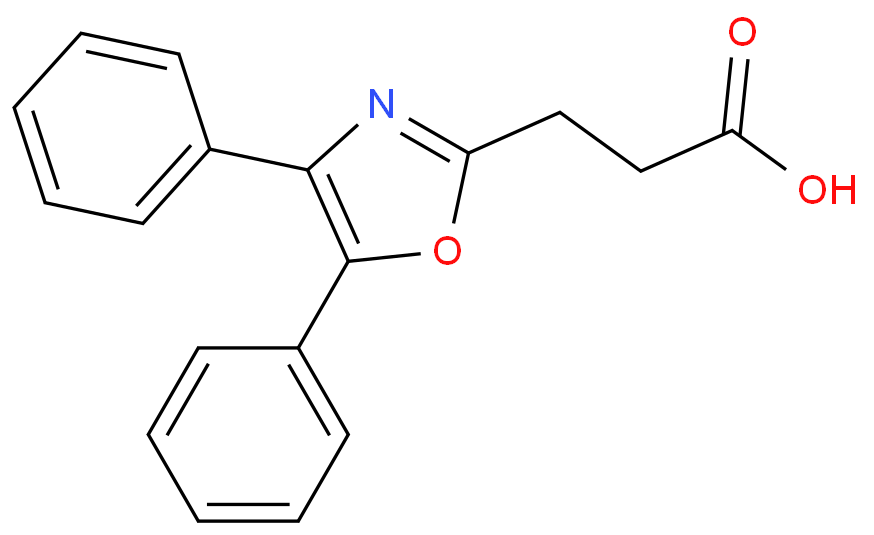
Oxaprozin, a propionic acid derivative NSAID, is similar to naproxen and ibuprofen. Like other NSAIDs, oxaprozin is a potent cyclooxygenase (COX-1 and -2) inhibitor that reduces the synthesis of pro-inflammatory prostaglandins, which are strong mediators of pain and inflammation. Oxaprozin provides analgesic, antipyretic, and anti-inflammatory effects.
On October 29, 1992, the FDA approved oxaprozin as a small-molecule COX inhibitor for the treatment of rheumatoid arthritis (RA) and juvenile RA. Oxaprozin is used to alleviate pain, tenderness, swelling, and stiffness caused by osteoarthritis (arthritis caused by the breakdown of the joint lining) and rheumatoid arthritis (arthritis caused by swelling of the joint lining). It is also used to relieve pain, tenderness, swelling, and stiffness in children aged 6 and older with juvenile rheumatoid arthritis.


Oxaprozin is an NSAID that reaches peak plasma concentration 2 to 6 hours after oral administration. It binds extensively to plasma albumin in a concentration-dependent manner. The plasma concentration-time curve (AUC) of oxaprozin is linearly proportional to the oral dose, with a maximum dose of up to 1200 mg. Doses above 1200 mg increase the unbound portion of the drug, resulting in an increased clearance and distribution volume (Vd) of oxaprozin. Accumulation of the drug at steady state is 40% to 58% lower than predicted from single-dose data. After multiple doses, the apparent oral clearance (CL/F) and Vd of total oxaprozin increase, while the apparent oral clearance and Vd of unbound drug decrease significantly. Oxaprozin has high concentrations in synovial fluid, which is a proposed site of action for NSAIDs. The drug is eliminated after biotransformation to glucose conjugates, which are excreted in the urine and bile, with minimal unchanged drug excretion. Two hydroxy metabolites have been confirmed to have anti-inflammatory activity. Liver disease and rheumatoid arthritis do not significantly alter the distribution of oxaprozin. In patients with renal impairment, the free plasma concentration of oxaprozin increases.
How long does it take for oxaprozin to work? Oxaprozin is well absorbed in the gastrointestinal tract. While food may delay its absorption, it does not affect its bioavailability. Once-daily dosing can achieve steady-state plasma levels within 4 to 7 days. The onset of action is relatively quick, usually providing noticeable pain relief within an hour of administration. However, its anti-inflammatory effects may take longer to become apparent, typically starting to show initial effects within a week of use. In more severe cases, the onset may be extended to two weeks or longer. Additionally, the full therapeutic effect of the drug usually requires several weeks to become fully apparent.
Oxaprozin, as an NSAID, is excellent at relieving pain and reducing inflammation. However, despite its effectiveness in treating conditions like arthritis, it must be used with caution. Individual responses to the drug can vary based on health conditions, so it is essential to consult a doctor before starting or adjusting oxaprozin treatment. A doctor will provide professional guidance based on personal health conditions and specific needs to ensure safe and effective use of the medication.
[1]https://www.1mg.com/generics/oxaprozin-210437?srsltid=AfmBOoodMKD5gtSFBiWSJ-HuPjwgDvxjcAwKEBGSiTlbLeMJzlAowaSX
[2]Carl P. Weiner, Clifford Mason, O, Editor(s): Carl P. Weiner, Clifford Mason, Drugs for Pregnant and Lactating Women (Third Edition), Elsevier,2019,Pages 624-650,ISBN 9780323428743,https://doi.org/10.1016/B978-0-323-42874-3.00014-8.
[3]https://www.sciencedirect.com/topics/pharmacology-toxicology-and-pharmaceutical-science/oxaprozin
[4]https://pubmed.ncbi.nlm.nih.gov/9884815/
[5]https://www.mayoclinic.org/drugs-supplements/oxaprozin-oral-route/proper-use/drg-20069737
[6]https://go.drugbank.com/drugs/DB00991
[7]https://dailymed.nlm.nih.gov/dailymed/lookup.cfm?setid=d9b0ca6c-4c53-4f6e-918b-02a8c472a194
[8]https://en.wikipedia.org/wiki/Oxaprozin
[9]Guo Hong. Design and evaluation of oxaprozin transdermal drug delivery system[D]. Shenyang Pharmaceutical University, 2007.
[10]https://medlineplus.gov/druginfo/meds/a693002.html
 |
 |
 |


 4YRS
4YRS