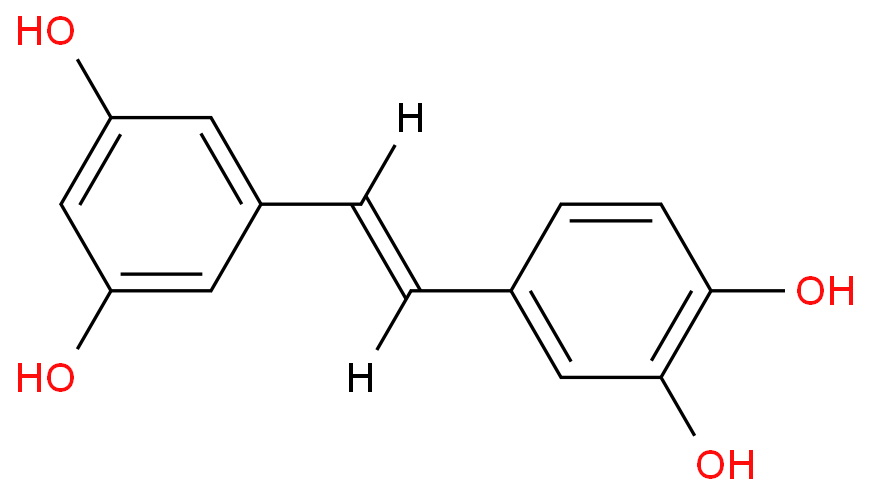
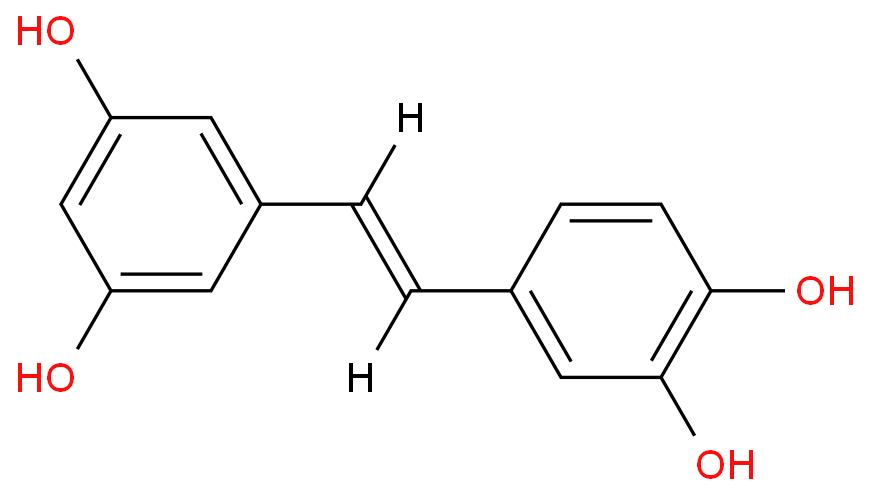
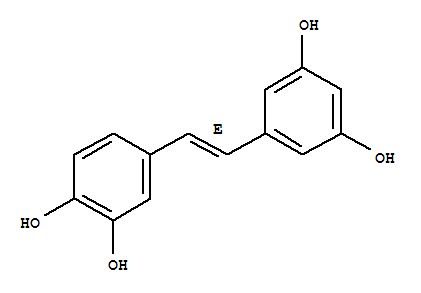
Among the stilbene compounds, resveratrol and piceatannol are well-known. Specifically, resveratrol is reported to have significant health benefits, such as anticancer and anti-inflammatory properties, longevity extension, and antidepressant effects. Piceatannol, a naturally occurring hydroxylated analog of resveratrol, has been less studied compared to resveratrol but shows extensive biological activity. Recent research on piceatannol has revealed its various pharmacological activities, including antitumor, cardiovascular disease prevention, antioxidant, hepatoprotective, and apoptosis induction effects. It also has the advantages of low toxicity, easy availability, and cost-effectiveness. Resveratrol structure and piceatannol structure are shown below:

Resveratrol and piceatannol structures
Piceatannol, with the molecular formula ((HO)2C6H3)2CH)2, has a chemical structure similar to resveratrol but features four hydroxyl groups instead of the three found in resveratrol. This difference may result in more pronounced glucuronidation or sulfation (metabolite formation) of piceatannol. Unlike pterostilbene, piceatannol lacks methoxy groups. Methoxy groups are thought to contribute to the high bioavailability of pterostilbene by enhancing lipophilicity and reducing the number of modification and metabolite formation sites. Interestingly, piceatannol’s bioavailability is between that of resveratrol and pterostilbene, though its half-life is significantly longer than both. Due to the structural similarity, piceatannol’s mechanism of action is most closely related to that of resveratrol.
Piceatannol exhibits various biological effects and mechanisms similar to those of resveratrol. What is the mechanism of action of piceatannol? It acts as an antioxidant, antileukemic, anti-inflammatory, and anti-Epstein-Barr virus compound. It is also used in the treatment of cardiovascular diseases, atherosclerosis, inflammatory bowel disease, and for the prevention of oxidative stress and cell death caused by β-amyloid protein. Piceatannol induces apoptosis in melanoma cells by upregulating miRNA-181a and alleviates inflammation and oxidative stress in diabetic cardiomyopathy by modulating the Nuclear factor erythroid-2 related factor 2 (Nrf2)/Heme oxygenase 1 (HO-1) and Nuclear factor kappaB (NF-kB) pathways. Additionally, piceatannol significantly inhibits insulin receptor activation by regulating receptor phosphorylation, which is crucial for downstream signaling. It appears to suppress adipogenesis by inhibiting insulin receptor activity in preadipocytes, thus preventing type 2 diabetes. It may also stimulate osteoblast activity, leading to bone formation. Piceatannol can alleviate IL-1β-induced osteoarthritis (OA) chondrocyte inflammatory responses and improve OA in mice by activating Nrf2. Moreover, it exhibits anti-melanogenesis activity. Piceatannol also inhibits protein tyrosine kinase through its immunosuppressive activity, which may play a significant role in preventing transplant rejection. It regulates NF-κB activation through phosphorylation control, acting as an anti-inflammatory compound. This compound has also been shown to prevent interferon α-induced signal transducer and activator of transcription 3 (STAT3) inhibition and STAT3 phosphorylation in B and T lymphocytes. These findings suggest that piceatannol can hinder pro-inflammatory responses by modifying cellular targets.
Piceatannol’s growth inhibition and pro-apoptotic effects are achieved through cell cycle arrest, upregulation of Bid, Bax, Bik, Bok, and Fas, downregulation of P21(WAF1), Bcl-xL, BCL-2, clAP, activation of caspases (-3, -7, -8, -9), mitochondrial membrane potential loss, and cytochrome c release. It has been confirmed to inhibit the activation of certain transcription factors, including NF-kappaB, which plays a central role as a transcriptional regulator in response to free radicals, UV exposure, cytokines, or microbial antigens causing cellular stress. Piceatannol also inhibits JAK-1, a key member of the STAT pathway crucial for controlling cellular responses to extracellular cytokines and an enzyme involved in inflammation and carcinogenesis, COX-2. By reducing ribonucleotide reductase activity, piceatannol further promotes its anti-proliferative effects. Piceatannol has been shown to induce apoptosis in cancer cells and has instances of its anti-apoptotic and pro-proliferative activities. It can inhibit osteosarcoma (OS) cell proliferation and induce apoptosis through the Phosphatidylinositol 3 kinase (PI3K)/AKT/Mechanistic target of rapamycin (mTOR) pathway, as well as through the miRNA21/phosphatase and tensin homolog (PTEN)/protein kinase B signaling pathway. Piceatannol inhibits Syk kinase, which plays a crucial role in coordinating downstream signaling pathways in various hematopoietic cells. It also binds to estrogen receptors and stimulates the growth of estrogen-dependent cancer cells. Piceatannol is rapidly metabolized in the liver, primarily converting to glucuronide conjugates; however, sulfation is also possible according to in vitro studies.
Piceatannol, as a multifunctional natural compound, reveals its enormous scientific potential through its mechanisms of action in cellular signaling, antioxidant, and anti-inflammatory activities. In-depth research into piceatannol not only broadens our understanding of its biological effects, but may also open up new research areas and applications. To further explore and utilize the scientific value of piceatannol, readers are encouraged to visit Guidechem to find piceatannol suppliers. Guidechem allows you to easily find reliable suppliers and make purchases, advancing your research efforts.
[1]Jiang Qinghua, Chen Jinming, Zhou Yongqin, et al. Research progress on the anti-infection effect and mechanism of piceatannol [J/OL]. Chinese Patent Medicine, 1-7[2024-09-18]. http://kns.cnki.net/kcms/detail/31.1368. R.20240816.1736.004.html.
[2]Yang Mingyi. Exploring the therapeutic effect of piceatannol on rheumatoid arthritis through network pharmacology and experimental verification[D]. Yan'an University, 2022. DOI:10.27438/d.cnki.gyadu.2022.000020.
[3]https://www.sciencedirect.com/topics/neuroscience/piceatannol
[4]Yagasaki K. Phytochemicals, their intestinal metabolites, and skeletal muscle function[M]//Nutrition and skeletal muscle. Academic Press, 2019: 421-438.
[5]Piotrowska H, Kucinska M, Murias M. Biological activity of piceatannol: leaving the shadow of resveratrol[J]. Mutation Research/Reviews in Mutation Research, 2012, 750(1): 60-82.
[6]Seyed M A, Jantan I, Bukhari S N A, et al. A comprehensive review on the chemotherapeutic potential of piceatannol for cancer treatment, with mechanistic insights[J]. Journal of agricultural and food chemistry, 2016, 64(4): 725-737.
 |
|


 15YRS
15YRS