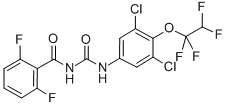
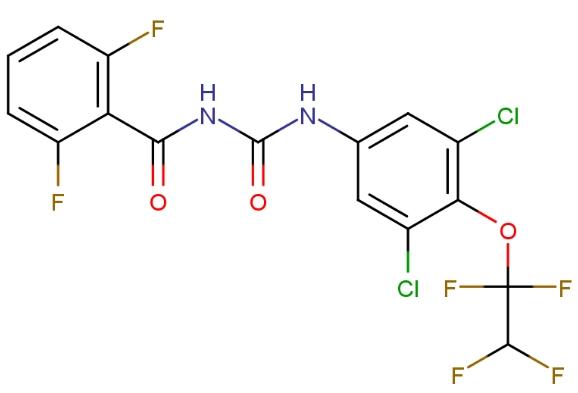
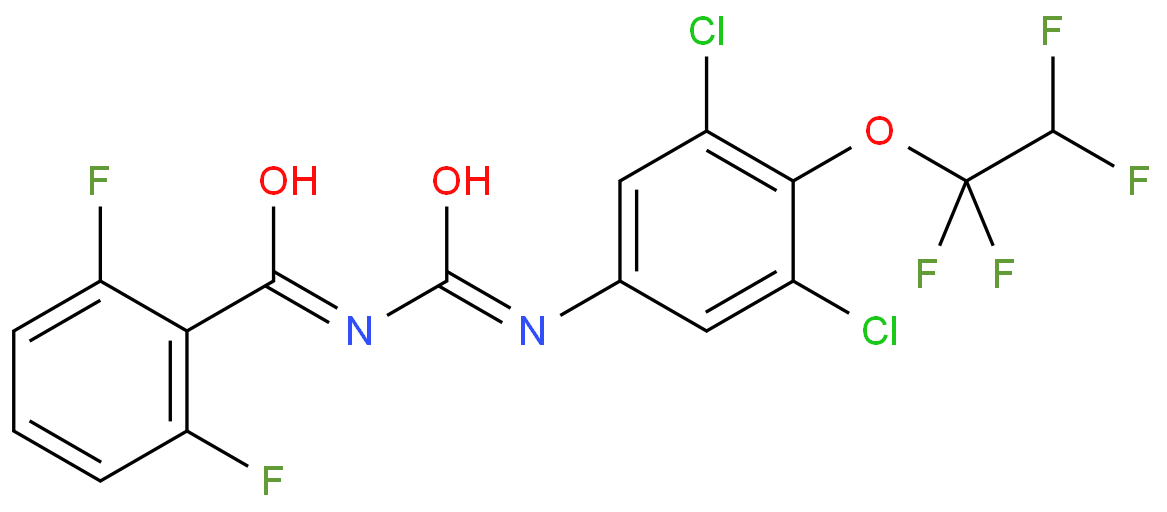
Hexaflumuron, initially registered in the United States in 1994, serves as a termite killer. What is the use of hexaflumuron? This chemical is employed in termite inspection, monitoring, and baiting systems. It stands as the first active ingredient registered by the EPA as a low-risk pesticide. Low-risk pesticides are those the EPA deems posing lesser risks to human health and the environment compared to existing alternatives. Hexaflumuron's chemical structure is as follows:
Hexaflumuron functions as a chitin synthesis inhibitor, targeting and eradicating termite colonies. It propagates effectively throughout the entire colony via trophallaxis, an exchange of liquids. Termite metabolism of hexaflumuron is slow, leading to an eradication rate of up to 100%. Hexaflumuron has also shown positive results in combating grapevine moths, bean beetles, and Asian rice borers. Formulations containing hexaflumuron have been utilized in residential insect control.
Hexaflumuron, a benzoylurea insecticide, exhibits excellent insecticidal and ovicidal activities. It is primarily employed in the control of pests such as cotton bollworms, tomato fruit borers, and various orchard pests. Notably, hexaflumuron proves highly effective against termites, the primary pests damaging wooden structures.
Hexaflumuron functions by gradually but thoroughly eliminating termite colonies. The specific methods include:
A. Termites consume bait containing hexaflumuron.
B. They share the bait with other termites through a social behavior called trophallaxis.
C. Hexaflumuron disrupts chitin synthesis, a crucial component of termite exoskeletons.
D. Termites fail to molt properly, ultimately leading to death.
E. As worker termites share the bait and subsequently perish, the termite colony weakens and eventually dies out.
The Environmental Protection Agency (EPA) classifies hexaflumuron as a low-risk pesticide due to:
A. Its usage in enclosed bait stations, minimizing exposure to humans, pets, and the environment.
B. Targeted application reduces impacts on non-target insects.
C. When used according to label instructions, hexaflumuron poses minimal risks to humans and pets due to its low toxicity.
Termite Colony Eradication: Hexaflumuron eradicates entire termite colonies rather than individual termites.
Transfer Effect: Termites share bait, leading to widespread distribution within the colony.
Reduced Risks: Compared to traditional liquid termiticides, hexaflumuron has minimal environmental impact and is safer for humans and pets.
Monitoring required: Bait stations need to be monitored regularly to track termite activity and treatment progress.
Hexaflumuron is employed in the control of pests in crops such as cotton, tomatoes, peppers, cruciferous vegetables, apples, peaches, and citrus fruits. It primarily targets various orders of pests, including lepidopteran pests, aphids, and thrips.
Hexaflumuron indirectly enhances crop yield and quality by reducing pest damage. By controlling these pests, crops can allocate energy towards growth, resulting in higher yields. However, it's essential to note that hexaflumuron itself does not directly improve yield or quality.
Vector-borne diseases, including malaria, dengue fever, lymphatic filariasis, schistosomiasis, Chagas disease, leishmaniasis, Zika virus disease, yellow fever, Japanese encephalitis, and tick-borne diseases, constitute approximately 17% of the global disease burden. Over half of the global population resides in areas at risk of two or more major vector-borne diseases. Despite variations in pathogens, epidemiology, burden, and existing treatment methods, all vector-borne diseases share a commonality: they are transmitted by vectors such as mosquitoes, midges, reduviid bugs, blackflies, snails, or ticks, which can be disrupted through vector control. Indeed, vector control interventions have proven crucial for controlling and eliminating most vector-borne diseases.
Vector control interventions heavily rely on the action of chemical insecticides, which can be applied on surfaces, bodies of water, aerial sprays, or impregnated into long-lasting mesh materials.
Hexaflumuron serves as an insecticide for termite control. While its primary use is termite control, it also provides some public health benefits by preventing termite infestations, which could damage property and potentially displace people. Termite infestations pose significant threats to homes and other structures. In severe cases, termite infestations render buildings uninhabitable. By preventing termite infestations, hexaflumuron can help safeguard public health by ensuring people have safe and secure housing.
The Environmental Protection Agency (EPA) regards hexaflumuron as a low-risk pesticide. This designation indicates that the EPA has determined hexaflumuron to have minimal impacts on human health, minimal toxicity to non-target organisms, and low potential for groundwater contamination.
Presently, hexaflumuron is not approved for veterinary use in the United States and Europe. Hexaflumuron serves as the active pharmaceutical ingredient (API) in ALPHA FLUX? 100 mg/mL concentrated liquid, utilized for bathing salmon to treat sea lice infestations. It is currently approved for use in Chile. Hexaflumuron is used to treat and prevent infections of Caligus rogercresseyi, a marine ectoparasite, in juvenile salmon. It is diluted to a concentration of 2 ppm in closed immersion tanks.
As of now, hexaflumuron has not received or conditionally approved as a drug for any fish species in the United States, nor is it registered for use in food in the United States. Thus, PHARMAQ requests the establishment of import tolerances for hexaflumuron in processed fish imported for human consumption in the United States. The establishment of import tolerances is an agency action of the U.S. Food and Drug Administration (FDA) that requires preparation of an environmental assessment (EA) unless the action meets the categorical exclusion criteria under 21 CFR Part 25 Subpart C.
Hexaflumuron is specifically utilized to kill termites. Due to its method of application and relatively low toxicity to mammals and birds, the United States Environmental Protection Agency (EPA) considers it a low-risk pesticide. The breakdown of hexaflumuron in the environment is as follows:
Hexaflumuron binds strongly to soil particles and has low solubility in water. This implies that it is unlikely to leach groundwater. Most of the hexaflumuron applied in the environment eventually enters the soil. A small amount may enter the air or water, where it degrades relatively quickly under sunlight and moist soil conditions.
Hexaflumuron exhibits high toxicity to aquatic invertebrates, such as insects and crustaceans, living in water. Concerns arise if insecticides accidentally spill into water bodies or if runoff from treated areas enters waterways. However, hexaflumuron is nearly non-toxic to birds and mammals.
When used according to label instructions, hexaflumuron poses relatively low risks to humans and wildlife. However, taking measures to minimize its impact on aquatic ecosystems is crucial.
The versatility and widespread application of hexaflumuron make it a crucial tool in both agricultural and sanitation sectors. Whether in crop protection or disease control, it demonstrates significant effectiveness and value. With ongoing advancements in science and continued focus on environmental safety, we can anticipate hexaflumuron playing an even greater role in future applications, further contributing to agricultural production and public health.
[1] https://www.pestmanglobal.com/solution/pestman-termite-bait-eliminate-the-entire-termite-colony/
[2] Yu, J., Wu, H., He, Y., et al. Efficient liquid chromatography analysis of hexaflumuron raw material. World Pesticides, 2023, 45(09): 51-54. DOI:10.16201/j.cnki.cn10-1660/tq.2023.09.09.
[3] https://www.fda.gov/media/
[4] https://www.ncbi.nlm.nih.gov/pmc/articles/PMC8115796/
[5] https://www.chicocrop.com/products/hummer-hexaflumuron-5-ec-insecticide/
[6] https://www.caymanchem.com/product/18598/
|
 |
 |


 2YRS
2YRS