
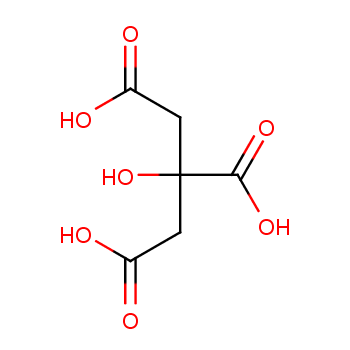
Citric acid is a crystalline, weak organic acid found in most plants and many animals, serving as an intermediate in cellular respiration. With three carboxyl groups, it is classified as a tricarboxylic acid. The term "citrus" has its origins in the Greek word kedromelon, meaning apple of melon, referring to the citron fruit. Greek works mention kitron, kitrion, or kitreos for citron, a fruit from the Citrus medica tree. Lemons and limes exhibit a high citric acid content, constituting up to 8% of the fruit's dry weight. Jabir ibn Hayyan (Geber, 721–815) is credited with discovering citric acid, while its isolation was first achieved in 1784 by Swedish chemist Carl Wilhelm Scheele (1742–1786) from lemon juice.
Citric acid, a weak acid, releases hydrogen ions from its three carboxyl groups (COOH) in solution. This results in the formation of the citrate ion, C3H5O(COO)33?, through the loss of hydrogen ions. Citric acid also forms intermediate ions during ionization. The citrate ion forms salts, such as calcium citrate, with metals. Various citrates, like trimethyl citrate and triethyl citrate, are produced through ester formation.
Industrial citric acid production commenced in 1860 and was dominated by Italian producers for the next 60 years. The initial production method involved extracting citric acid from citrus fruit juice by adding calcium oxide (CaO) to form calcium citrate (Ca3(C6H5O7)2), a precipitate collected through filtration. Sulfuric acid was then used to recover citric acid from its calcium salt. In 1893, Carl Wehmer reported sugar fermentation for citric acid production using the fungus Citromyces. P?zer, a leading producer, began mass production in 1919 under the guidance of James N. Currie, a food chemist for the U.S. Department of Agriculture.
P?zer's development of citric acid production methods during the 1920s led to the collapse of the Italian citric acid industry, which controlled 90% of the global market in 1922. By 1929, P?zer produced all its citric acid. The company refined its production methods, introducing the deep tank method for submerged fermentation, resulting in increased productivity and efficiency. By 1940, the cost of a pound of citric acid had significantly decreased from $1.25 in 1920 to about $0.20.
The contemporary production of citric acid employs both the surface tray and deep tank methods. In the surface process, sterilized air circulates over a medium layer comprising sugar (typically dextrose or molasses), salts, and nutrients. Over a period of 6 to 10 days, Aspergillus niger spores introduced on the surface ferment the sugar. While this method is not utilized in the United States, it is more prevalent in less industrialized nations. The fermentation cycle for this process spans from 5 to 14 days.
Contrastingly, the deep tank (submerged) process, occurring over 5 to 10 days in stirred stainless steel tanks or aerated towers, is favored for large-volume production in the industrialized world. This method necessitates less labor, occupies less space per volume of citric acid produced, is easier to maintain under sterile conditions, and yields higher production capacity. However, a drawback of the deep tank process is the higher energy costs. Citric acid yield from submerged culture fermentation processes can vary between 80% and 95% per weight of sugar. Following fermentation, the separation of citric acid from the broth is achieved by treating the broth with calcium hydroxide (Ca(OH)2) to precipitate calcium citrate. Citric acid is then regenerated from the calcium citrate by treating it with sulfuric acid.
Citric acid and its citrate compounds find extensive application across numerous industries. In 2005, global citric acid production reached 1.6 million tons, with China contributing approximately 40% of the world's supply. In the United States, about 65% of citric acid is utilized in the food and beverage industry. Its uses include imparting tartness, pH control, preservation, antioxidant properties, metal chelation, and stabilization of color and taste. Citrate salts serve as mineral and metal dietary supplements; for instance, calcium citrate functions as a calcium supplement. The second most significant application of citric acid is in detergents and cleaning products, where sodium citrate acts as a builder. Approximately 10% of citric acid production is allocated to the pharmaceutical industry, primarily for its use as an effervescent agent in products like Alka-Seltzer.
In cellular respiration, citric acid is formed within the mitochondria through a series of chemical reactions known as the citric acid or Krebs cycle. This cycle, named after Hans Adolf Krebs, begins with the combination of acetyl coenzyme A and oxaloacetate to produce citryl coenzyme A, ultimately leading to the production of citrate. The cycle continues with oxidation and reduction reactions, culminating in energy production. NADH and FADH2, produced in this process, move to the electron transport chain, where they undergo further reactions, releasing energy to synthesize ATP through oxidative phosphorylation (see Adenosine Triphosphate).
Richard L. Myers (2009). The 100 Most Important Chemical Compounds: A Reference Guide. Greenwood Publishing Group. October 1, 2009. https://doi.org/10.1021/ed086p1182
 |
 |
 |



 1YR
1YR


