What is C12H22O11?
Sucrose, with a chemical formula of C12H22O11, is a compound commonly known as table sugar. It is a white, odorless, crystalline powder with a sweet taste. Sucrose is soluble in water and plays a crucial role in the human diet as a source of energy. It is a disaccharide composed of glucose and fructose units linked by a glycosidic bond. Its molecular structure features a combination of carbon, hydrogen, and oxygen atoms arranged in a specific configuration that imparts its unique properties. Polarity is one of the important nature of molecules. Understanding the polarity of C12H22O11 is crucial in comprehending its behavior in various chemical reactions. So do you know the polarity of C12H22O11? Is C12H22O11 polar or nonpolar?
What is polarity?
Polarity describes the uneven distribution of electrons in a molecule or compound. In chemistry, the polarity of a molecule refers to the uneven distribution of positive and negative charges, resulting in the molecule having positive and negative poles. This uneven distribution is typically due to differences in electronegativity between atoms.
Electronegativity is a measure of an atom's ability to attract electrons. The polarity or non-polarity of a bond between two atoms is determined by the electronegativity of the constituent elements. When there is a significant difference in electronegativity between two atoms, with an electronegativity difference ranging from 0.5 to 2, one atom will attract the shared electron pair more strongly, causing the electron pair in the covalent bond to be skewed toward one atom, giving it a partial negative charge, while the other atom carries a partial positive charge. In this case, the molecule exhibits polarity.
Polar molecules display unique behaviors in chemical reactions and physical properties such as solubility, melting point, boiling point, etc. These properties make polar molecules important in many chemical and biological processes. What about C12H22O11? Is C12H22O11 polar or nonpolar?
Polarity of C12H22O11
Is C12H22O11 polar or nonpolar? Sucrose is an intriguing compound because it consists of multiple hydroxyl (OH) groups, which are polar in nature. Why is C12H22O11 polar?
(1) Dipole Moment
The hydroxyl groups in sucrose create regions of partial negative and partial positive charges due to the difference in electronegativity between oxygen and hydrogen. These polar bonds are arranged asymmetrically within the molecule, leading to an overall dipole moment. The cumulative effect of these individual dipole moments does not cancel out, resulting in a net dipole moment. This overall dipole moment makes sucrose a polar molecule.
(2) Electronegativity
| Element Electronegativity |
| O |
3.44 |
| H |
2.20 |
The difference in electronegativity (3.44 - 2.20 = 1.24) is significant enough to create a polar bond.
Although the molecule also contains nonpolar carbon-hydrogen (C-H) bonds, the numerous polar hydroxyl (O-H) bonds dominate the molecular polarity.
The overall electronegativity of sucrose's structure contributes to its high polarity.

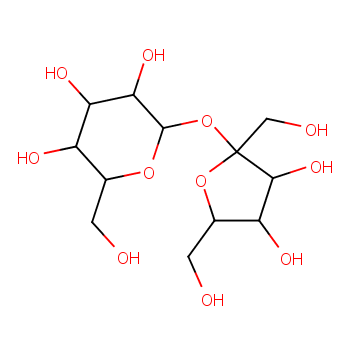
Molecule Structure of C12H22O11
Therefore,
sucrose, C12H22O11, is a polar molecule.
Application of C12H22O11 Polarity
Sucrose's polarity makes it highly soluble in water, an essential property for its use in the food and beverage industry. It is commonly used as a sweetener and preservative in various products.
Its high polarity also affects its interaction with other substances, making it an important ingredient in pharmaceuticals for masking unpleasant tastes and improving the texture of medications. Furthermore, the polarity of sucrose is significant in biological processes, as it influences how sucrose is metabolized and utilized by living organisms.
Highlight of Sucrose
| Sucrose Cas 57-50-1 |
| Molecular formula |
C12H22O11 |
| Molecular shape |
Complex structure with multiple rings |
| Relative molecular mass |
342.30 g/mol |
| Solubility |
Soluble in water, slightly soluble in alcohol |
| Melting point |
186 °C (decomposes) |
| Boiling point |
Not applicable (decomposes before boiling) |




 2YRS
2YRS