
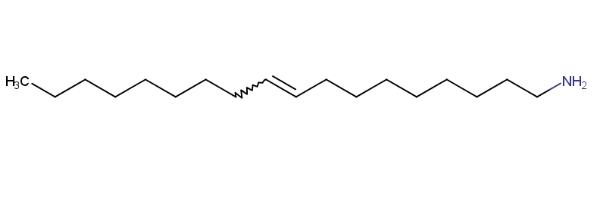
Oleylamine is a well-known terminating ligand used in the synthesis of various metal and semiconductor nanomaterials. The molecule has been widely studied in the field of phosphine-free colloidal quantum dot growth. Oleylamine can be used as a passivation layer in silicon solar cells to improve device efficiency. Doping self-assembled oleylamine networks into MoS2 transistors can increase carrier concentration from 0.7 × 1012 cm-2 to 1.9 × 1013 cm-2. Oleylamine belongs to the primary aliphatic amine family, and its chemical structure is similar to oleic acid, except for the terminal group COOH (the terminal group in oleylamine is NH2). Amine-carbonyl hydrogen bonds are widely studied in pigments such as indigo, Tyrian purple, quinacridone, and ring indole ketones, as well as in biomolecules like DNA and proteins. Due to its two hydrogen atoms covalently bonded to the nitrogen atom, oleylamine readily forms hydrogen bonds with adjacent molecules.
Oleylamine is utilized as an organic intermediate and textile auxiliary, and can also serve as a reducing agent and surfactant in the preparation of precious metal nanoparticle catalysts.
Oleylamine is used in the chemical synthesis and capping of nanoparticles, such as Fe3O4, poly(2-hydroxyethyl methacrylate) grafted poly(ε-caprolactone), titanium dioxide, and mesoporous silica.
Wet chemistry in organic solvents has proven effective for preparing various types of metal, metal oxide, and semiconductor nanostructures. Oleylamine (OAm) acts as a multifunctional reagent in the synthesis of various nanoparticle systems, serving as both a surfactant and stabilizer. OAm can form complexes with metal ions of the corresponding precursor, producing metastable compounds that can decompose in a controlled manner to generate nanoparticles. Stable particles with OAm can often be dispersed in various organic solvents, producing solutions with long-term enhanced colloidal stability and potential applications in many fields.
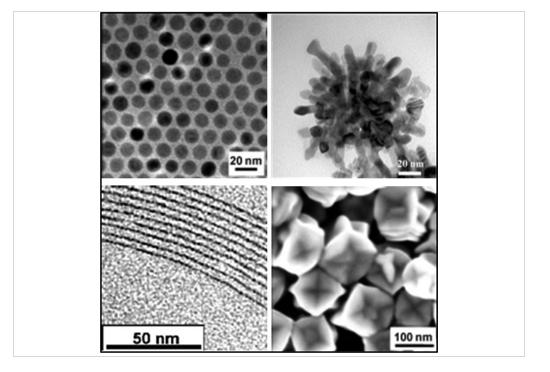
In the laboratory, oleylamine is used for synthesizing nanoparticles. It can serve both as a solvent for the reaction mixture and as a coordinating agent for stabilizing particle surfaces. It also coordinates with metal ions to modify the form of metal precursors and influence the kinetics of nanoparticle formation during synthesis.
Oleylamine demonstrates multiple functions in the synthesis of metal nanoparticles. It acts both as a reaction solvent and a surfactant. By coordinating with metal precursors, oleylamine can control nanoparticle growth, resulting in specific sizes, morphologies, and crystal structures. Additionally, the alkyl chain on oleylamine molecules can effectively adsorb onto the nanoparticle surfaces, forming a stable organic coating that prevents particle aggregation.
Due to its unique molecular structure, oleylamine is an important raw material for synthesizing high-performance surfactants. As a long-chain fatty amine, oleylamine has excellent lipophilicity, while its amine group imparts hydrophilicity. Through further chemical modifications, oleylamine can be transformed into various types of surfactants, such as cationic and amphoteric surfactants. These surfactants have widespread industrial applications, including use as emulsifiers, dispersants, and wetting agents in detergents, cosmetics, and the petroleum industry.
Oleylamine, as a distilled amine-based emulsifier and dispersant, is suitable for use in inks, paints, and coatings due to its corrosion resistance.
One of the main advantages of using oleylamine is its efficiency and effectiveness. In synthesis, oleylamine often serves as a key reactant or catalyst, aiding in the formation of desired compounds with high yields and minimal by-products. Additionally, oleylamine can enhance the performance of coatings, improving adhesion, durability, and resistance to environmental factors.
In addition to its technical benefits, oleylamine offers significant economic advantages. Compared to other chemicals, oleylamine is generally less expensive, making it an attractive choice in industrial production. The wide availability of oleylamine further enhances its usability. These economic benefits make oleylamine a valuable material for industries aiming to optimize production processes and reduce costs.
Oleylamine exhibits a broad range of applications across multiple industrial fields, from the synthesis of metal nanostructures to the preparation of surfactants and corrosion resistance. Exploring these uses can bring significant benefits to various production and research processes. For more information on oleylamine supply and market options, visit the Guidechem website. There, you can find information on relevant suppliers and detailed procurement data to help make informed decisions.
[1]https://en.wikipedia.org/wiki/Oleylamine
[2]https://baike.baidu.com/item/%E9%A1%BA%E5%BC%8F%E6%B2%B9%E5%9F%BA%E4%BC%AF%E8%83%BA
[3]https://pubs.acs.org/doi/10.1021/acs.chemmater.8b04198
[4]https://www.nature.com/articles/s41598-020-76703-0
[5]Mourdikoudis S, Liz-Marzán L M. Oleylamine in nanoparticle synthesis[J]. Chemistry of Materials, 2013, 25(9): 1465-1476.
[6]https://www.mdpi.com/2079-4991/12/17/3015
[7]https://onlinelibrary.wiley.com/doi/10.1002/14356007.a02_001
[8]https://www.sigmaaldrich.com/US/en/product/aldrich/o7805
|
 |
 |


 3YRS
3YRS


