Mineral oil is a mixture of colorless, odorless, light alkanes derived from mineral sources, especially petroleum distillates, and is different from typical edible vegetable oils. The name "mineral oil" is not precise and has been used for various specific oils over centuries. Other imprecise names include "white oil," "paraffin oil," "liquid paraffin" (a highly refined medicinal grade), and "liquid petroleum."
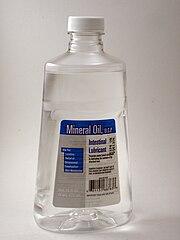
Most mineral oil is obtained from refining crude oil to produce gasoline and other petroleum products. Mineral oil used for lubrication is specifically called base oil. More generally, mineral oil is a transparent, colorless oil mainly composed of alkanes and cycloalkanes, related to petroleum jelly. Its density ranges from 0.8 to 0.87 g/cm3. Below is an image of a bottle of mineral oil sold in Canada:
Paraffin wax commonly refers to a group of saturated hydrocarbons with the formula CnH2n+2, where n is greater than 20. It exists in both solid and liquid forms. Solid paraffin, discovered by Carl Reichenbach in 1830, mainly comes from petroleum. Paraffin oil used as fuel is also called kerosene. Hard paraffin, a mixture of solid hydrocarbons, is also known as paraffin. It is used to harden ointments and creams and for coating capsules and tablets. Before the introduction of silicone, paraffin was once used in cosmetic surgeries, such as breast augmentation. It is also utilized in bismuth iodoform paraffin paste (BIPP). Liquid paraffin is a mixture of liquid hydrocarbons, mainly used as a lubricant laxative, though its side effects make it less recommended.
Liquid paraffin and mineral oil are essentially the same, differing only in the degree of refinement. Liquid paraffin, also known as liquid paraffin, paraffin oil, liquid petrolatum, or Russian mineral oil, is a highly refined mineral oil. According to the 4th edition of the "Handbook of Specialty Chemicals," mineral oil is a mixture of liquid hydrocarbons obtained by treating petroleum with sulfuric acid, fuming sulfuric acid, or a combination of both, primarily composed of saturated C15 to C50 hydrocarbons. Mineral oil is a colorless, odorless, oily liquid, insoluble in water and alcohol, but soluble in benzene, ether, and volatile solvents. It was one of the earliest lubricants used by humans, known for its wear resistance, thermal stability, and heat resistance. Paraffin oil accounts for 85% to 90% of total mineral oil consumption.
However, this changed after the two oil crises, as petroleum resources became scarce and mineral oil prices soared, making it unaffordable. Researchers also found that mineral oil contributes to the greenhouse effect, and no method for its biodegradation has yet been discovered, meaning it will continue to harm the environment on which we depend.
Mineral oil is also known as paraffin oil, white mineral oil, and liquid paraffin. The term "mineral oil" is not entirely accurate, as it covers various specific types of oil. Similarly, terms like liquid paraffin and liquid petroleum are also imprecise. Broadly speaking, mineral oil consists mainly of alkanes and cycloparaffins. Refined mineral oil is classified into three types, one of which is paraffin oil, based on normal alkanes. British pharmacologists use the term "full paraffin" to refer to light mineral oil and "semi-paraffin" for thicker mineral oil. The term "liquid paraffin" often appears on ingredient lists of baby oils and cosmetics.
Paraffin is a mixture of several higher alkanes, primarily n-docosane (C22H46) and n-octacosane (C28H58), containing about 85% carbon and 14% hydrogen. Paraffin oil is a mineral oil, a colorless and odorless mixture obtained from crude oil distillation. Liquid paraffin, a mineral oil, comes in two forms: heavy liquid paraffin or light liquid paraffin. Light liquid paraffin is the highest-grade refined mineral oil. Paraffin oil, primarily composed of hydrocarbons, is used in food, medicine, and industry.
Yes. Warm melted paraffin is used as a heat therapy method. In this application, paraffin is mixed with mineral oil in a 6:1 or 7:1 ratio to lower the melting temperature of paraffin from 54°C (129°F) to between 45°C and 50°C (113°F to 122°F). Because paraffin has low specific heat and thermal conductivity, it can be safely used at this temperature. Mineral oil is used to reduce the melting point of paraffin to a safe level for use on patients. Paraffin baths are typically used to treat hands or feet and are best for areas that can be immersed in paraffin.
[1]https://baike.baidu.com/item/%E7%9F%B3%E8%9C%A1%E6%B2%B9
[2]https://en.wikipedia.org/wiki/Mineral_oil
[3]https://en.wikipedia.org/wiki/Liquid_paraffin_(drug)
[4]https://en.wikipedia.org/wiki/Paraffin_wax
[5]https://baike.baidu.com/item/%E7%9F%B3%E8%9C%A1%E6%B2%B9
[6]https://www.sciencedirect.com/topics/materials-science/paraffin-oil
[7]https://www.sciencedirect.com/topics/chemical-engineering/paraffin-wax
 |
|
 |



 1YR
1YR

