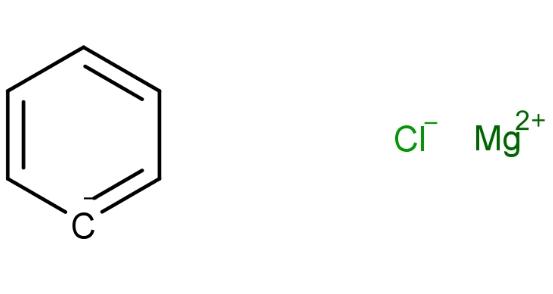
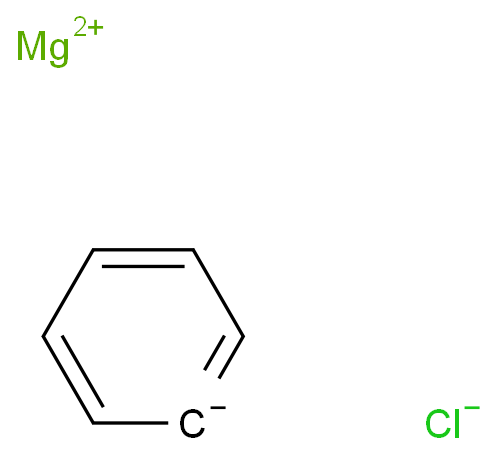
Phenylmagnesium chloride is an aryl magnesium halide. It is used as a Grignard reagent in organic synthesis, particularly in the production of hydrocarbons, alcohols, ketones, organic acids, amines, organosilicon compounds, and boranes. Currently, phenylmagnesium chloride is a crucial raw material for synthesizing triphenylphosphine. Triphenylphosphine is an organic compound with the chemical formula C18H15P, mainly used in organic synthesis, as a polymerization initiator, and as a raw material for the antibiotic chloramphenicol. It is also a standard sample for organic trace analysis of phosphorus. The structure of triphenylphosphine is as follows:

Phenylmagnesium chloride is primarily used as a Grignard reagent in organic synthesis, especially in the production of hydrocarbons, alcohols, ketones, organic acids, amines, organosilicon compounds, and boranes.
Phenylmagnesium chloride is utilized in various cross-coupling reactions. A notable example is the cross-coupling reaction between 1,3-dichloroisoquinoline and phenylmagnesium chloride, resulting in pure 3-chloro-1-phenylisoquinoline (71%).
S. Miyazaki and others isolated a novel T-shaped tri-coordinated nickel (I) chloride with an N-heterocyclic carbene ligand, NiCl(IPr)2 (IPr = 1,3-bis(2,6-diisopropylphenyl)imidazolin-2-ylidene), through the reaction of Ni(0)(NHC)2 with aryl halides. This Ni(I) complex has been confirmed as a catalyst for cross-coupling reactions between aryl halides and phenylmagnesium chloride.
Palladium-catalyzed cross-coupling reactions between aryl magnesium halides (such as phenylmagnesium chloride, meta-diphenylbromomagnesium, 4-(methoxycarbonyl)phenylmagnesium chloride, and 4-cyanophenylmagnesium chloride) and halogenated pyridines allow for the synthesis of substituted pyridines. The reaction conditions are mild (usually below 0°C), allowing extension to functionalize halogenated pyridines, quinolines, and diazines.
Jack H. Stocker and others observed stereoselectivity in several reactions, forming a second adjacent asymmetric carbon atom. The effects of transitioning from phenyl lithium to phenyl iodomagnesium, and then from phenyl bromomagnesium to phenylmagnesium chloride, were studied. Results showed that with phenyl lithium or phenyl iodomagnesium, the product dl:meso ratio was greater than 1, whereas with phenyl bromomagnesium or phenylmagnesium chloride, the product dl:meso ratio was less than 1.
Phenylmagnesium chloride has been used to convert selected nitroaromatics into nitrosoalkenes. These insert into adjacent sp2 CH bonds to produce functionalized heterocycles. W. Dohle and others used phenylmagnesium chloride to gently synthesize multifunctional benzimidazoles and indoles by reducing functionalized nitroaromatics.
Oren Mizrahi and others developed an electrolyte solution for rechargeable magnesium batteries based on phenylmagnesium chloride (PhMgCl) Lewis base and AlCl3 Lewis acid reactions in ethers. The THF solution of (PhMgCl)2-AlCl3 exhibited optimal performance: highly reversible Mg deposition (100% cycling efficiency), low overvoltage (<0.2 V), and a wide electrochemical window of more than 3 V. These solutions can achieve a specific conductivity of 2-5 x 10⁻³ Ω-1 cm-1 between -10 and 30°C, similar to standard lithium battery electrolyte solutions.
Phenylmagnesium chloride reacts with water, steam, or acids, producing toxic and flammable vapors. It poses a significant fire hazard and is highly flammable. Phenylmagnesium chloride is listed by the DEA (Drug Enforcement Administration) as a monitored chemical for clandestine drug manufacture. Disposal must consider the chemical’s impact on air quality, potential migration in air, soil, or water, effects on animal, aquatic, and plant life, and compliance with environmental and public health regulations. Alternatives with lower occupational hazards or environmental pollution tendencies should be used when possible.
The production and use of phenylmagnesium chloride in organic synthesis and as a Grignard reagent can lead to its release into the environment through various waste streams. Phenylmagnesium chloride is listed by the DEA as a monitored chemical for clandestine drug manufacture. It reacts violently with water, making hydrolysis a primary fate process in air, soil, and water. Occupational exposure to phenylmagnesium chloride can occur through skin contact. The general population is unlikely to be exposed, except in rare cases near illegal drug manufacturing.
Due to its unique properties in chemical synthesis, phenylmagnesium chloride is widely used in fields such as organic synthesis. Due to its intense chemical activity and potential for misuse, it is listed by the DEA as a monitored chemical to prevent illegal use in drug manufacturing or other illicit activities. This measure aims to ensure the safe and legal use of phenylmagnesium chloride, while protecting the public from potential illegal misuse.
[1]Miyazaki S, Koga Y, Matsumoto T, et al. A new aspect of nickel-catalyzed Grignard cross-coupling reactions: selective synthesis, structure, and catalytic behavior of a T-shape three-coordinate nickel (I) chloride bearing a bulky NHC ligand[J]. Chemical communications, 2010, 46(11): 1932-1934.
[2]Mizrahi O, Amir N, Pollak E, et al. Electrolyte solutions with a wide electrochemical window for rechargeable magnesium batteries[J]. Journal of the Electrochemical Society, 2007, 155(2): A103.
[3]https://www.sciencedirect.com/science/article/abs/pii/B97800810075560001200
[4]Dohle W, Staubitz A, Knochel P. Mild synthesis of polyfunctional benzimidazoles and indoles by the reduction of functionalized nitroarenes with phenylmagnesium chloride[J]. Chemistry–A European Journal, 2003, 9(21): 5323-5331.
[5]Stocker J H, Sidisunthorn P, Benjamin B M, et al. The Effect of Changing Reagent upon Stereoselectivity1a[J]. Journal of the American Chemical Society, 1960, 82(15): 3913-3918.
[6]Bonnet V, Mongin F, Trécourt F, et al. Syntheses of substituted pyridines, quinolines and diazines via palladium-catalyzed cross-coupling of aryl Grignard reagents[J]. Tetrahedron, 2002, 58(22): 4429-4438.
[7]https://baike.baidu.com/item/%E4%B8%89%E8%8B%AF%E5%9F%BA%E8%86%A6
[8]https://www.sciencedirect.com/topics/chemistry/phenylmagnesium-chloride
[9]https://pubchem.ncbi.nlm.nih.gov/source/hsdb/5336
|
 |
 |



 1YR
1YR