
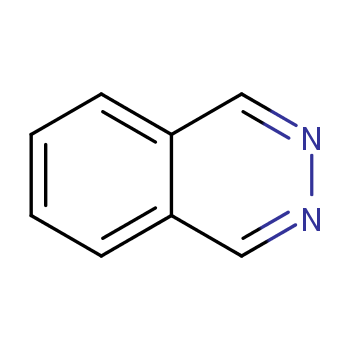
Phthalazine is a nitrogen-containing heterocyclic compound with a broad range of structures and pharmacological uses. Due to its pharmacological potential, it has garnered significant attention from medicinal chemists in the design and synthesis of new drugs. Specifically, the phthalazine framework appears as a pharmacophore in many biologically active drugs, especially those with anti-diabetic, anti-cancer, antihypertensive, anti-thrombotic, anti-inflammatory, analgesic, anti-depressant, and antimicrobial activities.
Phthalazine (benzobenzodiazine or benzopyrazine) is a class of heterocyclic compounds with a specific ring structure, holding an important place in organic chemistry. They are isomers of indole. The basic structure of phthalazine is C8H6N2, and it has traditionally been synthesized through the condensation of ω-tetrachloroxylene with hydrazine (D. Gabriel, Ber., 1893, 26, p. 2210) or by reducing chlorophthalazine with phosphorus and hydriodic acid (Ber., 1897, p. 3024).

Similar to pyrazine, phthalazine and other benzopyrazines are also synthesized by the condensation of hydrazine with carbonyl-containing compounds, typically phthalic acid esters. Recently, Napoletano and colleagues demonstrated the use of lactone chlorination condensation, an advanced intermediate in the synthesis of new PDE4 inhibitors I phthalazine. Similar chemical reactions are used to synthesize pyridyl (methyl) phthalazine, which acts as an inhibitor of VEGF receptor tyrosine kinase.
Parent compounds like pyrazine, pyrazine-phthalazine, and quinoxaline are available commercially. However, if synthesis is needed, pyrazine can be easily prepared through catalytic hydrogenation of 3,6-dichloropyrazine (the most readily available halogenated precursor). Phthalazine can be prepared similarly from 1,4-dichloropyrazine, although cyclization of α, α, α′, α′-tetrachloroxylene with hydrazine may be more economical. Phthalazine can also be synthesized by treating 1,4-dihydrazinopyrazine with oxygen in the presence of sodium hydroxide, yielding a 68% product.
The synthesis of phthalazine derivatives typically involves multistep procedures, ending with cyclization reactions, ring expansions, or aromatization of 1,2-dihydro or 1,2,4,5-tetrahydrophthalazine. Research has also reported the use of 1,2,4,5-tetrazines with aromatics and the inverse electron demand Diels-Alder (IEDDA) reaction of benzodiazepine with enamine as methods for synthesizing phthalazine derivatives. Gabriel and colleagues first synthesized phthalazine in 1893 through the cyclization of ortho-carbonylbenzaldehyde or 1,2-dichloromethylbenzene with hydrazine. This transformation, the cyclization of ortho-dicarbonyl with hydrazine, remains the standard route for preparing phthalazine. Phthalazines substituted at positions 1,4 with halogen groups are generally synthesized through the halogenation of 2,3-dihydrophthalazine-1,4-dione. However, these methods often require many synthetic steps, depending on the degree of substitution at positions 5 to 8. For instance, Tsoungas and others reported a six-step synthesis starting from 5-methoxy-2-nitrobenzaldehyde, eventually forming 6-methoxyphthalazine with a total yield of less than 20%. Another cyclization reaction involves aromatic aldehyde phthalazine, which occurs under harsh conditions in liquid AlCl3/AlBr3.
Simon N. Kessler and others proposed a universal method that not only allows the one-pot synthesis of 4- to 8-substituted phthalazines from simple aromatic aldehydes with good to excellent yields but also produces pyrazine heterocyclic compounds with similar yields. The key step in this new method is the conversion of aromatic aldehydes into directed ortho-metalated groups (DMG). Directed ortho-lithiation is an excellent method for forming ortho-substituted aromatic compounds and is widely used. Although aldehydes themselves are not directed groups, they can react with lithium amides to form R-amino alcohol salts, which then generate moderate to good DMG.
Overall, this research developed a new one-pot method for synthesizing phthalazine and pyrazine aromatic compounds from aromatic aldehydes. Various substituents, from electron-withdrawing to electron-donating, can be used, providing the desired 1,2-diazine with good to excellent yields. These products have been applied in the inverse electron demand Diels-Alder (IEDDA) reaction catalyzed by bidentate Lewis acids, opening a new two-step route for synthesizing substituted naphthalenes, such as naproxen, as shown in the figure below:

[1]https://en.wikisource.org/wiki/1911_Encyclop%C3%A6dia_Britannica/Phthalazines
[2]https://www.sciencedirect.com/topics/chemistry/phthalazine
[3]Sangshetti J, Pathan S K, Patil R, et al. Synthesis and biological activity of structurally diverse phthalazine derivatives: A systematic review[J]. Bioorganic & Medicinal Chemistry, 2019, 27(18): 3979-3997.
[4]Kessler S N, Wegner H A. One-pot synthesis of phthalazines and pyridazino-aromatics: a novel strategy for substituted naphthalenes[J]. Organic letters, 2012, 14(13): 3268-3271.
[5]https://pubs.acs.org/doi/10.1021/ol301167q
[6]Luo Mingjian. Study on the addition reaction of phthalazine salts with terminal alkynes[D]. Heilongjiang: Harbin Institute of Technology, 2019.
[7]https://www.sciencedirect.com/topics/medicine-and-dentistry/phthalazine
 |
|
 |



 15YRS
15YRS

