
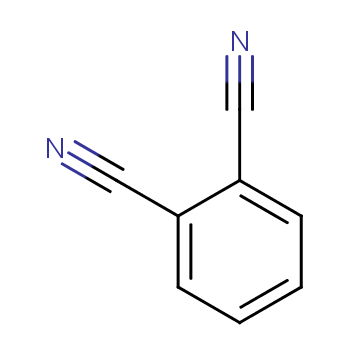
Phthalonitrile, also known as 1,2-dicyanobenzene or phthalonitrile, is an important organic synthesis intermediate with CAS number 91-15-6. Its molecular formula is C8H4N2, molecular weight is 128.13, melting point ranges from 137 to 139 °C, and its boiling point at atmospheric pressure is 304.6 °C. The pure substance appears as a grayish-white to yellow-brown powder. Phthalonitrile is an aromatic compound with two cyano (CN) groups attached to adjacent carbon atoms on a benzene ring.
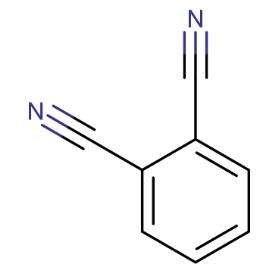
Phthalonitrile is primarily used as an intermediate in pigments and other fine chemicals, with a wide range of applications including the synthesis of phthalocyanine drugs, phthalocyanine pigments and dyes, high-heat-resistant polyamide fibers, dimethylphenyl, diisocyanate plastics, and desulfurization catalysts.
Phthalonitrile is a precursor for phthalocyanine pigments. Phthalocyanine pigments and dyes are widely used in inks, paints, plastics, rubber, and for coloring and dyeing cotton, silk, and synthetic fibers due to their excellent heat resistance, light resistance, acid resistance, alkali resistance, and solvent resistance. Phthalocyanine pigments are known for their heat resistance, light stability, acid resistance, alkalinity, and bright colors, and their production in Western developed countries has surpassed that of azo dyes, with widespread applications.
Since World War II, various industries have required lightweight polymer materials with metal-equivalent properties to replace heavy and expensive metal components. Few developed polymers meet these urgent needs. Phthalonitrile (PN) resins are one such polymer. PN resins are advanced polymer materials with outstanding performance, especially suited for extremely demanding applications such as aerospace and military uses.
As a newly developed thermosetting resin, phthalonitrile resin has shown potential applications in the electronics field due to its unique properties, such as low dielectric loss, dense cross-linked network, rich polycyclic aromatic hydrocarbon structure, high thermal stability, and mechanical properties. Additionally, the condensation rings built in phthalonitrile resin after high-temperature annealing allow it to be used as a conductive material. Research progress on phthalonitrile resins in electronic applications includes dielectric materials, radiation shielding materials, electromagnetic wave-transparent materials, electromagnetic interference (EMI) shielding materials, supercapacitors, and magnetoresistive (MR) materials. These insights are likely to have a significant impact on the field and help researchers explore new functions and applications of phthalonitrile resins in electronic devices in the future.
Raquel Nunes da Silva and colleagues synthesized phthalocyanines with four or eight sulfonamide units and evaluated their photodynamic inactivation effects against Gram-negative bacteria (E. coli) and Gram-positive bacteria (S. Aureus). Among the two bacteria, simpler sulfonamide unit compounds (N, N-diethylbenzenesulfonamide, N-isopropylbenzenesulfonamide, and N-(4-methoxyphenyl)benzenesulfonamide) showed stronger inactivation effects than those with heterocyclic groups (N-(thiazol-2-yl)benzenesulfonamide) or long alkyl chains (N-dodecylbenzenesulfonamide). Moreover, encapsulating the phthalocyanine-sulfonamide conjugates in polyvinylpyrrolidone micelles used as drug delivery carriers generally improved inactivation efficiency. The results suggest that encapsulated phthalocyanine-sulfonamide conjugates are promising photosensitizers for photodynamic antibacterial therapy.
According to the 2012 OSHA Hazard Communication Standard (29 CFR 1910.1200), this chemical is considered hazardous. Its hazards are summarized as follows:
Phthalonitrile can form flammable dust concentrations in the air, and heating decomposition releases toxic fumes of hydrogen cyanide and NOx (cyanides and nitrogen oxides). Ingestion, skin contact, or inhalation are toxic, and it is harmful to aquatic life with long-lasting effects. Handling should be performed in a well-ventilated area with appropriate protective clothing.
[1]https://www.sciencedirect.com/science/article/abs/pii/S0223523418304136
[2]https://en.wikipedia.org/wiki/Phthalonitrile
[3]https://www.sciencedirect.com/science/article/abs/pii/B9780128129661000019
[4]https://pubs.rsc.org/en/content/articlelanding/2022/tc/d1tc05715d/unauth
[5]https://baike.baidu.com/item/%E9%82%BB%E8%8B%AF%E4%BA%8C%E7%94%B2%E8%85%88
[6] Ma Yulong, Zhou Xinhua, Yang Zhikuan, et al. Study on the synthesis of phthalonitrile[J]. Journal of Wuhan University (Science Edition), 2001, 47(6): 681-684. DOI:10.3321/j.issn:1671-8836.2001.06.007.
[7] Ma Yulong, Zhou Xinhua, Yang Zhikuan, et al. Synthesis of phthalonitrile by ammoxidation[J]. Fine and Specialty Chemicals, 2002, 10(11): 17-18, 20. DOI: 10.3969/j.issn.1008-1100.2002.11.007.
[8]Cong Linquan, Li Wenxiao, Ma Ying, et al. New synthesis process of phthalonitrile[J]. Dyes and Colorants, 2020, 57(03): 24-25+57.
[9]https://www.fishersci.com/store/msds
[10]https://pubchem.ncbi.nlm.nih.gov/compound/Phthalonitrile
 |
|


 6YRS
6YRS


