Benzoic acid, as an important organic compound, has wide applications and research value in the field of chemistry. The question of whether benzoic acid is polar or nonpolar has been a key issue in organic chemistry research. With both a benzene ring and a carboxyl group in its molecular structure, these two parts have different electrical properties, leading to discussions on the polarity of benzoic acid. In this article, we will delve into the polarity characteristics of benzoic acid and explore the influence of its molecular structure on its polarity properties.
Benzoic acid is a compound containing a phenyl ring nucleus with a carboxyl substituent. It acts as an antimicrobial food preservative, inhibitor of EC 3.1.1.3 (triglyceride lipase), inhibitor of EC 1.13.11.33 (arachidonate 15-lipoxygenase), plant metabolite, human xenobiotic metabolite, algal metabolite, and drug allergen. It is the conjugate acid of benzoate. Benzoic acid is widely used as a bacteriostatic compound in food preservation. It combines with glycine in the liver and is excreted as hippuric acid. In its sodium salt form, it is used to treat urea cycle disorders due to its ability to bind amino acids, resulting in decreased excretion of these amino acids and ammonia levels. Recent studies suggest that sodium benzoate as an adjunct therapy for schizophrenia (1 g/day) may be beneficial. Positive and negative symptom total scores decreased by 21% compared to placebo.
Understanding polarity in chemistry is crucial as it determines how molecules interact and behave. Polarity arises from differences in electronegativity of bonds. The dipole moment of a compound can be obtained from the polarity of its bonds and shape, thus allowing compounds to be easily categorized based on their molecular polarity. Now, let's delve into the significance of the polarity of benzoic acid.
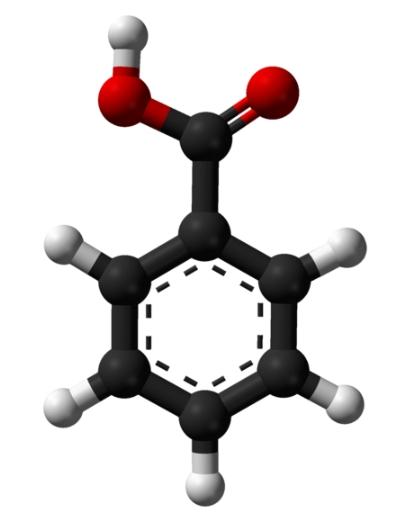
Benzoic acid (C6H5COOH) is a polar molecule. The polarity of benzoic acid depends on the presence of a polar carboxyl group (COOH) functional group. The C-O bond, C=O bond, and O-H bond in this group are all polar due to significant electronegativity differences between oxygen and carbon. This difference in electronegativity results in unequal sharing of electrons, causing the oxygen atom to carry a partial negative charge and the hydrogen and carbon atoms to carry a partial positive charge.
While benzoic acid indeed contains a nonpolar benzene ring, the influence of the polar carboxyl group is greater than the nonpolar benzene ring. This gives the entire molecule a net dipole moment, making it polar. Here's a summary of the key points:
(1) The carboxyl group (COOH) is polar due to electronegativity differences.
(2) The benzene ring is nonpolar.
(3) Due to the stronger influence of the carboxyl group, the entire molecule is polar.
Benzoic acid is a polar molecule influenced by the following factors:
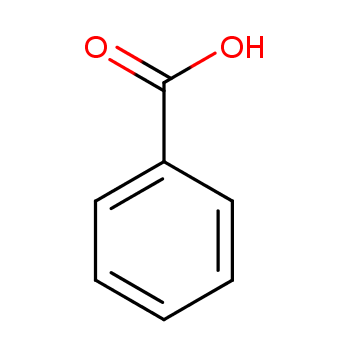
Benzoic acid has a benzene ring (six carbon atoms arranged in a hexagon) connected to a carboxyl group (C=O double bond and an O-H hydroxyl group). The presence of the oxygen atom carrying a negative charge in the carboxyl group is crucial.
Electronegativity refers to the tendency of atoms to attract electrons during bond formation. Oxygen has a significantly higher electronegativity than hydrogen and carbon. In the C=O bond, oxygen pulls the shared electrons closer to itself, causing the oxygen to carry a partial negative charge and the carbon to carry a partial positive charge. Similarly, oxygen attracts electrons in the O-H bond, causing oxygen to carry a partial negative charge and hydrogen to carry a partial positive charge.
The oxygen atom on the O-H group can participate in hydrogen bonding with another oxygen atom nearby (from another benzoic acid molecule or a water molecule). Hydrogen bonds create significant attraction between molecules, further affecting polarity.
Unequal sharing of electrons in the C=O and O-H bonds results in permanent partial charges in the molecule. Although the benzene ring itself is relatively nonpolar, the strong electronegativity of oxygen and the presence of hydrogen bonding make benzoic acid a polar molecule.
The benzoate ion (C6H5COO-) is polar. This polarity arises from two main factors:
The benzoate ion has a carboxyl group (COO-) containing polar covalent bonds. In these bonds, oxygen's electronegativity is stronger than carbon, so it has a stronger attraction to the shared electrons, resulting in a partial negative charge on the oxygen and a partial positive charge on the carbon.
The arrangement of atoms in the carboxyl group allows it to form hydrogen bonds with nearby molecules, such as water molecules. Hydrogen bonds are strong attractions between a hydrogen atom and a highly electronegative atom (such as oxygen) and another electronegative atom. Water molecules are polar and can form hydrogen bonds with benzoate ions, making them soluble in water.
Although the benzoate ion has a benzene ring (C6H6) which is nonpolar, the presence of the highly polar carboxyl group masks its nonpolar characteristics, giving the entire ion polarity.
Salicylic acid is more polar than benzoic acid. Both molecules contain carboxyl groups (COOH), which contribute significantly to polarity. However, salicylic acid has an additional hydroxyl group (OH), further increasing its polarity.
(1) Benzoic acid: Polar due to the carboxyl group but with relatively low topological polar surface area (tPSA) of approximately 37.3 (a measure of polarity).
(2) Salicylic acid: Higher polarity due to the presence of both the carboxyl group and the hydroxyl group. Compared to benzoic acid, it has a higher tPSA, approximately 57.5.
The higher tPSA of salicylic acid indicates its stronger ability to form hydrogen bonds with water and other polar molecules, making it more soluble in polar solvents.
The polarity of benzoic acid plays a crucial role in its various cross-industry applications.
(1) Plasticizer: The moderate polarity of benzoic acid makes it a suitable plasticizer. It helps increase the flexibility of polymers by reducing intermolecular forces between polymer chains.
(2) Corrosion Inhibitor: Due to the polarity of benzoic acid, it can form a protective layer on metal surfaces, aiding in corrosion prevention.
The polarity of benzoic acid contributes to its antifungal and antibacterial properties, making it a valuable ingredient in topical ointments and some medications.
As a food preservative, the polarity of benzoic acid allows it to dissolve well in water and distribute throughout the food and beverage. This inhibits the growth of microbes that could cause spoilage.
In this article, we delved into the question of whether benzoic acid is polar or nonpolar, revealing its polarity characteristics through analysis of its molecular structure and electrical properties. As an important organic compound, the polar nature of benzoic acid is crucial for understanding its behavior in chemical reactions and solutions. Research into the polarity properties of benzoic acid allows for a deeper understanding of its properties and applications, providing valuable insights for further exploration in the field of organic chemistry.
[1]https://pubs.rsc.org/en/content/articlehtml/2020/ra/d0ra06742c
[2]https://pubchem.ncbi.nlm.nih.gov/compound/Benzoic-Acid
[3]https://homework.study.com
[4]https://www.toppr.com/guides/chemistry/aldehydes-ketones-and-carboxylic-acids/salicylic-acid/
[5]https://www.echemi.com/community
[6]https://in.pinterest.com/pin/is-benzoic-acid-polar-or-nonpolar-polarity-of-benzoic-acid--644437027949994517/
 |
 |
 |


 2YRS
2YRS


