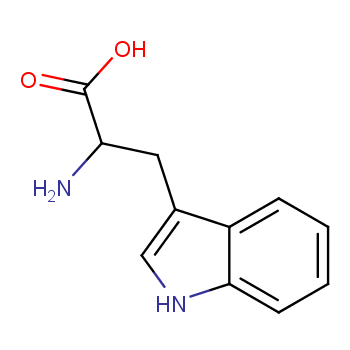
The Lewis structure of a compound like Tryptophan73-22-3 can provide insights into its molecular composition, including the arrangement of atoms and the nature of the bonds between them. Tryptophan, often denoted as Trp, is a naturally occurring amino acid with a complex structure that includes a benzene ring, an indole group, and a side chain. Understanding its Lewis structure helps in comprehending its chemical reactivity and interactions within biological systems.
Tryptophan73-22-3 appears to be a specific compound identifier, possibly related to a particular isomer or variant of the amino acid tryptophan. However, standard chemical databases and literature do not directly reference "Tryptophan73-22-3." Tryptophan itself is a non-polar aromatic amino acid with the molecular formula C11H12N2O2. It features a unique indole ring attached to a side chain that contains a ketone and a hydroxyl group. Tryptophan plays critical roles in cellular metabolism and is essential for the synthesis of various biologically active molecules such as serotonin and melatonin.

Drawing the Lewis structure of Tryptophan involves considering the connectivity of its functional groups and ensuring that all atoms adhere to the octet rule. Here’s a simplified guide to sketching the structure:
Step 1: Begin with the Indole Ring: The indole ring is the backbone of Tryptophan, featuring a nitrogen atom at position 2 and a double bond between positions 1 and 2. The nitrogen atom at position 3 carries a lone pair of electrons, while the carbon at position 5 has a hydroxy group (-OH) attached.
Step 2: Add the Aromatic Ring: Adjacent to the indole ring, there is a benzene ring. Connect the nitrogen at position 2 of the indole to a carbon of the benzene ring with a single bond. This carbon should have a methyl group (-CH3) attached to it.
Step 3: Incorporate the Ketone and Hydroxyl Groups: The side chain includes a ketone group (C=O) and a hydroxyl group (-OH). Attach these groups to the appropriate carbon atoms of the benzene ring, ensuring that all atoms have a complete octet.
Step 4: Finalize the Structure: After connecting all atoms, verify that the structure accurately represents the molecular formula and functional groups of Tryptophan73-22-3. Ensure all atoms have a complete octet, except for hydrogen atoms, which often have a tetrahedral arrangement around them.

The molecular geometry of Tryptophan73-22-3 is determined by the spatial arrangement of its atoms, influenced by the indole ring, the benzene ring, and the side chain. The indole ring has a complex structure, while the benzene ring maintains a flat, aromatic structure. The side chain introduces some degree of flexibility and irregularity due to the presence of the methyl group and the ketone and hydroxyl groups. The overall geometry is complex and is influenced by the interactions between the aromatic rings and the side chain.
As Tryptophan73-22-3 is a hypothetical identifier, it is difficult to provide specific information about its functions. However, Tryptophan itself is a crucial amino acid that serves as a precursor for neurotransmitters such as serotonin and melatonin, which play roles in mood regulation, sleep, and circadian rhythms. Additionally, Tryptophan is essential for the synthesis of the vitamin niacin and is involved in protein synthesis and immune function.
Tryptophan73-22-3 seems to suggest a modification or variant of the standard tryptophan. Amino acids, including tryptophan, are interconnected through various metabolic pathways. Tryptophan can interact with other amino acids in processes like protein synthesis, the urea cycle, and the citric acid cycle. Variants might exhibit altered properties or functionalities depending on the specific modifications introduced by the "73-22-3" identifier.
Standard tryptophan is a naturally occurring amino acid found in many proteins in foods. Variants like Tryptophan73-22-3 might refer to synthetic derivatives or modifications of the natural amino acid. Synthetic variants could be created in laboratories for research purposes or specialized applications, potentially altering its biological activity compared to the naturally occurring form.
Health effects associated with Tryptophan73-22-3 would depend on its specific chemical structure and modifications. Since it is a hypothetical compound, its impact on human health cannot be definitively stated without detailed information about its chemical composition and intended use. However, tryptophan itself is known to contribute to the synthesis of essential neurotransmitters and vitamins, influencing mood, sleep quality, and overall health.
|
 |



 3YRS
3YRS